Saturday, August 09, 2008

In Memoriam Leo Zwell

History is a damn dim candle
over a damn dark abyss
-- W.S. Holt


My grandfather Leo Zwell died last week at age 92, so I thought I'd write a blog post (inadequately) commemorating his existence and lamenting his passing.

Leo and me, 1967

What a really exceptional person he was, and how glad I am to have known him.

He was a crystallographer by profession, and a really outstanding grandfather, but most of all I'll remember him as two things (in no particular order):

  • an inquisitive, careful, always-processing, generally-interested mind
  • a caring, loving human who always wanted to help, and to see that others were doing well
His attitude toward humanity was a subtle one, alluded to by a phrase I remember from a poem I wrote for him and my grandmother when I was 18 or so: "Cynically and with innocence." Of course, this is a rather typically Eastern-European-Jew sort of almost-but-not-quite-self-contradictory attitude, but he manifested it in a uniquely warm and thoughtful way.

He saw humans as hopelessly flawed, screwed-up animal creatures, dealt a mixed hand by evolution (a frequent saying of his was, "We're really just animals. Considering that we're really just animals like all the other animals, we're really not so bad ... we've actually come a long way.") -- yet he was dedicated to getting the most out of the flawed human-animal mind by understanding the world around him and encouraging others to do the same ... and to helping others nudge their flawed human existences in the direction of satisfaction and growth and cognizance rather than suffering and foolishness....

He thought people sometimes expected too much of humanity, given that after all we're just animals with mildly hyperdeveloped craniums. But then, he was also prone to push people to think more and more, to consider perspectives and avenues beyond what their culture or personality or habitual mind-set presented them with. It wasn't exactly "hope for the best, expect the worst" -- more like "expect the mixed-up and confused, but keep pushing for the better and better."

In conversations and in his own thinking on everyday or scientific topics, he was always willing to approach the world simply, in the manner of a child, just looking at reality without preconceived notions ... yet was also extremely interested in accumulating knowledge, and critical of people who govern their thinking and living in an ignorant way.... He was always great with children (at least until his very last years, when he occasionally became impatient), and one of the things he liked about kids was their natural inclination to be scientists and observers: he was always concerned to carefully and openly observe the world around him (and within him) and see what was actually there.

On a personal level, he was extremely important to me in two specific ways (beyond just being a loving and helpful family member), connected to the two qualities. I mentioned above...

Firstly: He was the one who got me into hard science, in the first place. Both of my parents were into social change and social science and such, and the general milieu of my early youth was left-wing hippie nonconformists, not hard scientists concerned with understanding physical or mathematical reality. Whenever we visited Leo (and we moved near him when I was 6, so I saw him often after that) he lectured me on physics, chemistry, biology, mathematics and what-not ... and he had an endless reserve of stories about experiments he'd done, famous and non-famous scientists he'd worked with, and so forth.

Leo taught me some practical things about science and math, such as tricks for doing mental arithmetic ... and simple trigonometry, Newton's method, the basics of X-ray diffraction and so forth -- but that wasn't really the main point ... I could learn that stuff from books ... the main point was his enthusiasm for science and his immersion in the culture of science ... in the culture of thinking, learning, and communicating with a goal of incrementally understanding more and more about the world.... The cognitive/adaptive/communicational attitude was something he applied to every aspect of existence, including everyday human life, but he saw the scientific sphere as the place where thought and in-depth communication could really flourish.

The other major gift he gave me was: As a child, he was the only example I saw, up-close, of a man who had gotten really deeply into taking care of his kids. My father Ted Goertzel was a very good father and I learned an awful lot from engaging with him in wide-ranging intellectual conversations throughout my childhood ... we also traveled a lot together and played sports together and did many other rewarding things ... but, in our house as a child it was my mom who did the vast bulk of childcare. Leo on the other hand had taken on a large amount of the responsibility for taking care of my mother and her brother, himself -- and I could see this, even as a child myself, in the nature of his relationship with his adult children. I thought this was pretty interesting, and I could see that both he and his children had gained a huge amount from this (at the time, quite unusual) pattern.

Seeing the relationship between Leo and my mom was a lot of what imprinted me with the idea that caring for my kids was something I was supposed to do myself (another thing pushing me in this direction, was probably my mother's own radical-feminist emphasis on male-female equality) ... an idea that continues to absorb a significant portion of my life, as I have ~50% shared-with-my-ex-wife custody of my two still-under-18 kids (my oldest, Zar, is 18 and now a junior in university: damn that makes me feel old!!).

It is impossible for me to estimate the amount of personal reward I've gotten from following Leo down the child-caring path ... or the amount to which my thinking about human and AI cognition has been influenced by carefully observing and partaking of the mental and emotional development of my 3 kids....

These days it is not that shocking for a father to take an intensive hands-on role, but for Leo's generation it was anomalous, and -- while there were some specific situational reasons that pushed him in this direction, such as some temporary health problems on his wife's part -- I'm sure much of the the reason he took on this role as intensively as he did was just his overall passion for being helpful. His kids needed and valued his help, so from his view, it would have been unnatural not to provide as much help as was sensibly possible. He could have left it to his wife, but as a rule, he never really was one to leave things to others (another meme I've adopted from him: I too like to Get Things Done, and have a strong tendency toward getting them done myself rather than relying on others...).

I only knew Leo for the last 41/92 of his life, and I'm not going to try to convey nearly all that I knew of him, but I hope the observations I'll make here will transmit some meaningful (if tiny) fraction of the essence of the person.

This blog post will be sort of disorganized (it already is, and I'm just getting started!) ... I'm going to jump around in time a bit ... but that's the way memory works ... and anyway, as Leo and I discussed a few times, modern physics tells us the directionality of time is projected by the perceiving mind...

The end was distressing but, at least, not marked by great suffering. Leo's body faded gradually during the last few years, with an especially fast decline in the last 6 months after a surgery ... his death itself was about as humane as deaths get, with his daughter (my mother, who did an incomprehensibly great job of caring for him during his last years, all while holding down a very demanding more-than-full-time job running a social service program) at his side. He spent much of his last few hours listening to family members bid him farewell over the phone, and then he curled up in a fetal position and reluctantly let his worn-out body shut down.

One of the most interesting things about the last few years was what an astute observer he was about his own mental and physical deterioration. As each aspect of his functioning declined (arithmetic ability, memory for faces, memory for names, sense of direction), he would note this and analyze the particular nature of the deterioration. And he worried to the end about imposing a burden on his family, to which we would always reply that he had helped us a huge amount in the earlier part of his life, so we were more than happy to return the favor.

Indeed, helping others was -- as I already hinted above -- one of the biggest themes of Leo's life. The receptionist at the old folks' home where he lived for his last few years (Martin's Run) likes to tell a story about the day that Leo felt she looked bored and hungry sitting at her desk by the entrance, so he went to the kitchen and brought her some soup. Walking was slow for him at that time, but, he thought it was imperative that the receptionist be treated well. I don't remember any of the other residents at Martin's Run paying nearly so much attention to the well-being of the hired staff. But this meme went way back in Leo's life, to his roots growing up in Brooklyn during the Great Depression, and then his political involvement in socialist organizations a little later on.

(His interest in socialism was never an abstract or theoretical thing; while, as a scientist, he appreciated very much the value of good theories with explanatory power, he never took much stock in social theories, considering them largely mumbo-jumbo. His interest in socialism was always very practical: he saw the world as full of people who needed help, and he thought that society should be organized in such a way that they got the help they needed. After the truth about the Soviet Union became clearer in the 1970's and 1980's he backed away from the more Marxist variants of socialism, but remained strongly attached to the caring-oriented values at the heart of the democratic socialist tradition.)

The (woefully inadequate) obituary in the Philadelphia Inquirer, after his death, read as follows:

Leo Zwell, 92, a retired scientist with the Joint Committee of X-Ray Powder Diffraction Standards in Swarthmore, died of heart failure on Wednesday at Martin's Run, a retirement community in Media where he had lived since 2002.

Mr. Zwell was a physicist with the Jet Propulsion Laboratory at the California Institute of Technology, U.S. Steel, and the U.S. Bureau of Standards before joining the Swarthmore firm in 1972.

He was a 1934 graduate of Brooklyn College. "He graduated at the age of 19," said his son, Michael, chief executive officer of his own human resources firm in Chicago.

"He was working full time" while in college "to put himself through school and contribute to his family's income," his son said. In the depths of the Depression, there was no money for advanced studies.

The Joint Committee, Michael Zwell said, is a publisher of research about X-raying of materials "to identify what their atomic structure was."

Besides his son, he is survived by his daughter, Carol Goertzel; sisters Gladys Berman and Priscilla Endler; four grandchildren; and a step-grandchild.

Mr. Zwell's wife of 54 years, Etta, died in 1994.

A memorial service will be held at 12:30 p.m. today at Martin's Run, near Route 320 and Paxon Hollow Road outside Media.

A spokeswoman for the Humanity Gifts Registry said Mr. Zwell had donated his body to science.


(Small digressive note: Perhaps the most peculiar thing about this obituary is its failure to mention that my mother Carol Goertzel runs a very successful social service program in the Philadelphia area. Apparently some obituary-writers don't do much homework.)


me and my mom Carol (Leo's daughter),
kickin' it old school back in the good old days ...
1968 or so, Eugene, Oregon,
in the midst of all the hippy madness...
but I was more concerned with my box
than science or revolt or the Vietnam war...

Leo graduated high school at 14 (so he wound up entering college at 15, just as I did ... though he was a younger 15) and went to Brooklyn College, where he majored in chemistry. Unlike me (whew!) he worked full-time while in college, helping out in his father's parking garage (which he found rewarding though at times exhausting ... and one of his favorite topics of discourse was the incredible ethical and intellectual characteristics of his father, Pop Charlie ... Charlie Zwagilski before immigrating to the US from Eastern Europe and getting his name mutated).

Pop Charlie (holding my sister Rebecca)
and Grandma Sarah (holding me)


Pop Charlie before I knew him, back in the day

Not too long after graduating college Leo joined the WWII war effort, stationed in the lab rather than the battlefield, working on various projects related to creating better metallic compounds for use in missiles and other military devices. Like many others of that time, he found his innate tendency to pacifism called into question by the Nazi threat. All or nearly all of his relatives who had not emigrated to the US, were wiped out in one or another anti-Jewish purge in Eastern Europe.

After the war ended, he spent some time as a researcher at the Jet Propulsion Laboratory in California, but eventually had to leave there due to McCarthyism: he was actively involved in efforts to politically organize scientists and engineers, and was hence falsely accused of un-Americanism. This episode had a lasting impact on his psyche, imprinting him with a cynicism about human nature and society that never quite left him after that. But, he went on to a very successful research career at US Steel in Pittsburgh, a major industrial research lab of its time ... and then after "retiring" from US Steel, spent 20 years working at the Joint Committee of X-Ray Powder Diffraction Standards in Swarthmore PA, where he pored over the crystallography research literature and figured out which of the many results published there seemed solid enough to enter into JCPDS's extensive databases.

(I briefly had a job helping him him with some of his JCPDS work during the summer of 1982, after my first year of college, but my duties consisted largely of photocopying and I confess I rapidly quit the job even though the small amount of pay was useful to me ... I did not, and still don't, have the patience to enjoy that sort of work....)

Leo during the JCPDS period


Had he been born a little later (a complicated counterfactual, but let's roll with it for the moment...) he would surely have gotten a PhD; but in his day you could do serious science without one ... and he surely did a lot of it. One trait of his that I did not inherit was his surpassing modesty: though he was brighter and more knowledgeable than many of the more famous and well-recognized scientists in the labs he worked in, he genuinely did not envy their greater glory and external recognition. Rather, he was contented to work in the background, analyzing peoples' data for them, solving the tough problems that no one else could solve, and pushing science ahead by helping others with their work as best he knew how.

Another excellent trait of his that I did not inherit was his incredible carefulness. He would review a body of data again and again, with never-failing concentration and precision, looking for subtle patterns, or subtle clues that some sort of error or irregularity might have occurred. There were various commonly-used formulas in the crystallographic literature that he considered inaccurate because the data from which they were derived had various issues; and I have little doubt he was correct. While I am not cognitively suited to be as careful as he was, watching his approach to understanding data was extremely educational for me, and throughout my career I have sought to work with people who are careful in the same way that he was, knowing that this is a virtue I lack.

He also taught me the value of teams in science. My inclination is to be a lone wolf and seek to range far and wide from others trying to solve the hardest problems by idiosyncratic means -- but he showed me that in science, an awful lot of things can only be achieved via different people with different strengths working together. What I'm doing now in my own career exemplifies this: in my thinking I remain a pretty-far-out-there lone wolf, but I'm happy to be working with a diverse, well-integrated R&D team that probably shares many characteristics with the teams he worked in at US Steel.

One theme that he often returned to in his ruminations and (extensive, sometimes rather excessive!) storytelling was that of Generalists versus Specialists. He considered himself more of a generalist, as he was always seeking to synthesize knowledge from different areas, and look for overall patterns of organization. On the other hand he also had deep specialized knowledge of particular areas such as X-ray diffraction data analysis. Only by integrating generalist and specialist traits, he felt, was it possible to really make profound scientific progress. He saw too many scientists as being generalists or specialists only, and felt that for this reason a lot less progress was made than could otherwise be the case.

In part, it was probably his very humbleness that allowed him to be so helpful to so many other scientists, during the course of his career. As they knew he didn't care to compete with them, they were comfortable sharing their doubts, questions, ideas and hard problems with him. He was always interested in arguing intellectual points -- with anyone, be they a famous scientist or a two year old child -- but rarely was there any rancor involved ... it was very much passionate, abstract argumentation in the Greek tradition. Ideas meant a lot to him, yet it was rare for him to hold someone's bad ideas against them as a human being. He had friends with whom he profoundly disagreed.

I recall, when my sister Rebecca (now a school principal) was 6, Leo was lecturing her on the need to avoid fashionable clothing and such, because making fashion statements was foolish and involved emphasizing the wrong things. (He liked to say how he'd worn the same clothes all his life, and watched them go in and out of style.) Rebecca argued back that being determinedly unfashionable was itself a kind of fashion statement, so should also be avoided according to his principles. He laughed and agreed with her, quite willing to take-lightly his own studied unfashionableness, and complimented her on her thoughtfulness. (Of course, Rebecca ultimately grew up not to be the kind of person who reads fashion magazines....)

One of Leo's and my biggest, long-running arguments regarded the future of humanity.

He believed human nature to be fundamentally flawed, and figured that all attempts to reform society and improve human nature were doomed to fail, based on the fundamentally screwed-up essence of human nature. He saw the scientific process as having a greater perfection than human nature, but still being deeply flawed in various ways due to the underlying flaws in the humans doing the science (when led to, for example, wrong formulas being perpetuated because the individuals advocating them were famous or people were simply too lazy to study the underlying data correctly).

When I argued to him that science could in fact be used to improve human nature, by modifying the brain or by uploading people into computers, he basically laughed off the idea. Not that he felt it was impossible, but that he felt he didn't have the conceptual background to really think about it thoroughly. I really wish I had discussed these topics with him when he was 55 or 60 rather than 75-92, but it just didn't occur to me, mostly because our conversations were more dominated by his own (interesting) interests. The most evocative thing he ever said on this topic was something like: "Fine, Ben, but by the time you modify the human brain to remove all the ethical problems and the foolishness, what you'll have won't be human anymore."

In other words, he saw screwed-up-ness as essential to the nature of humanity ... and he understood himself as inextricably part of this human web of screwed-up-ness ... but nevertheless he felt compelled to devote himself to gaining more and more understanding and helping all the other screwed-up humans as much as possible.

Still, I always had the feeling that if we argued long enough, I might have been able to bring him around to a point of view closer to my own radical futurism. Another of his excellent qualities was his ability to change his ideas and attitudes -- no matter how deep-seated -- based on evidence and reflection. This was evident in his scientific work, and also in his personal life: for instance he was raised with relatively sexist and homophobic attitudes (by modern standards), but gradually revised these over time as he observed they really did not explain what he saw around him, nor accord with his desire for general human happiness.

I also remember arguing with him that it might, one day, be possible to resurrect the dead in a scientific way. My argument was: If quantum theory is correct then all the information about everything that has ever happened is encoded in the perturbations of particles in the universe now, so that in principle dead people could be reconstituted from this information, if a being were smart and powerful enough to collect it and do the appropriate nanoengineering. On the other hand, who knows if quantum theory is correct ... and there are, er, some engineering difficulties in this plan. Leo certainly found this train of thought amusing -- but he was not of the emotional cast to draw any hope from it. As far as he was concerned, once he was dead, he was gone, and that was the end of it ... remote possibilities regarding far-future weirdball engineering feats didn't really enter his emotional world. He did not want to die, but he accepted it, and had no patience for superstitions or wishful thinking.

Another comment he frequently made was that he was "never bored." He claimed not to really understand the concept of boredom. "I always have my own mind," he said. "How can I be bored? There's always so much to think about and to wonder about."

Indeed when your attitudes are "Question Authority!" and furthermore "Question Everything!" (two attitudes that came down to me from both sides of my family with pretty overwhelming force), boredom is hard to come by, because there are always so many things to be questioning....

Even at the end, in fact, when his powers of thought were a fraction of their previous, he STILL was never-bored, and was always thinking and trying to understand things. At the very end, when his memory was gone, he was continually asking questions about the objects in the hospital room: what is that? What is that for? Who put that there?

In his last few hours, right before he lost the energy to talk, he was counting ... he counted from 1 to 36, slowly and carefully, as if to be sure all the numbers were still there, as if by attaching himself to the Platonic realm of numbers he was connecting with a reality more substantial than his fading body and memory ... as a non-religious person, he had no delusions of heavens or hells, but beyond our own personal worries, concerns and attachments, there is always the more permanent and perfect world of the Numbers ...

He had a great love of measurement as a way of understanding the world, and when we emptied out his drawers, boxes and closets after his death, we found a remarkable number of rulers, yardsticks, protractors, compasses, calculators and slide rules. (At a certain point, in Swarthmore, he adopted the habit of asking each visitor to his apartment, as soon as they walked in the door, to name their height ... and then proceeding to measure them, taking his daily dose of kindly schadenfreude from observing how nearly all males tend to overestimate their own heights.) Perhaps his most prized personal possession was his watch: when in the hospital the nurses took his watch from him, he felt completely at a loss until it was returned. I was reminded of the historical theory that the main reason Western civilization advanced so much further than others (such as the Chinese) was the invention, in the middle ages, of quantification, of precise empirical measurement. His career was based on measuring things and recognizing patterns in these measurements, and he was concerned with this till the end.

Well ... having written all that, it still seems pathetically inadequate, and there is so much more to say. Most of all I have left off the very, very long list of people whom Leo and his wife Etta helped in various ways during their lives -- going beyond family and colleagues, comprising a remarkable assemblage of individuals whom they encountered in one random way or another and tried their best to help on their ways through life.

I loved all 4 of my grandparents (the others died some time ago) ... and my other grandfather, Victor Goertzel, was also an accomplished scientist (a psychologist) with whom I had considerable intellectual interaction (for instance, when I was in my early 20's, Victor and my grandmother Mildred and my father and I co-authored a biography of Linus Pauling together) ... but I have to say that Leo is the only grandparent whom I really internalized, to the point of view where I sometimes feel like I have a miniature Leo Zwell homunculus living in some obscure corner of my brain, pointing out to me when someone needs help, and pointing out to me when some point on a data chart is likely to be an outlier, and urging me to doubt all my beliefs and ideas, especially the ones that are most important to me.

One of my favorite phrases was taught to me by my friend Bruce Klein, founder of the Immortality Institute and my collaborator in Novamente LLC: "To abolish the plague of involuntary death."

Indeed: few goals are as important. So sad that it did not happen in time for Grandpa Leo.

He had a good life and a very useful one (not always happy, there were bouts of depression and the usual real-life troubles, but overall a richly rewarding human existence) ... but even at 92 years, I can't help thinking that this excellent person's life was far, far too short.

P.S. The photos included in this blog post are among the many we took from Leo's apartment after his death.


ISO a non-religious foundation for the process of "taking responsibility"

This is a re-post (with light edits) of a post I made last week, that got disappeared due to some IT difficulties regarding poor communication btw blogger.com and my Web hoster.

These were some late-night thoughts about the conceptual logic of morality and responsibility, written to the tune of Charlie Parker's glorious "Au Privave" (hot on the heels of "Step into the Realm" by the Roots, one of the few hip-hop bands I like at all...).

I guess what I am inching toward here is some sort of cognitive theory of moral responsibility ... but I'm really inching there, one teeny little piece at a time.... (Well, some topics lend themselves to speed better than others....)

I'll start with will, and then move on to my main topic of taking personal "moral responsibility" for one's actions.

Don't worry, I haven't turned into a preacher yet (though I haven't shaved for a while and am sporting a fairly spiffy Jesus-like beard, though I've been planning to shave for a few days and just haven't found the time), my basic orientation on these topics is one of systems theory....

So, for starters: Anyone with any sense knows by now that the intuitive feeling of "free will" we have is illusory. Our unconscious decides for us, before any conclusion is derived by the process of conscious ratiocination that feels like it's making a decision.

So why bother with the decision process at all? Why not just go with the flow of the non-ratiocinative unconscious? Because we know that the intensely-conscious decision process helps dynamically restructure our long-term memory in a way that will help our unconscious make better decisions in the future.

Next: Anyone with any sense knows that the notion of "moral responsibility" is, to a large extent, a hanger-on from obsolete religious belief systems.

And, the notion of "taking personal responsibility" for one's actions has -- in most particular instances -- questionable empirical grounding. After all, anything any one of us does, is to a large extent caused by our social and physical context -- as Saddam famously said in the South Park movie: "It's not my fault that I'm so evil ... it's society ... society...." Of course, it really IS society ... that cute little pseudo-Saddam wasn't lying ... and in any particular case, none of us really has the information to tease out the internal from the external causes underlying any of our actions ... but yet, this is a poor perspective to take, in spite of the element of truth underlying it.

(Causality, in the end, is not really a scientific concept anyway: it's a tool that minds use to understand the world. A causes B, from the perspective of mind M, if

  • A precedes B
  • The probability of events in class B is differentially higher, given the prior and correlated occurrence of events in class A.
  • M can fairly confidently analogize that, if it were to carry out some action similar to A, then some event similar to B might be likely to follow

But that's a topic for another blog post, another day ... and is covered to some extent in the last chapter of my co-authored book Probabilistic Logic Networks, which Springer is supposed to publish this month...)

Sooo .... Why bother with the process of "taking moral responsibility" at all? Because we know that doing so helps us structure our long-term memory in a way that will help our unconscious take better actions in the future.

When we do something we wish we hadn't done, the act of assigning "responsibility" to ourselves causes us to insert a "correction signal" into our unconscious, which then modifies the structure of our internal declarative/procedural knowledge base in a way that makes it less likely we'll do similar regret-worthy things in the future. This is the case even though we (i.e. the deliberative, ratiocinative, "decision process" aspect of ourselves) don't know that much (rationally or intuitively) about how the unconscious works, and can't really untangle the various causal threads weaving through our minds and our worlds and leading to our actions.

The "ordinary waking state of consciousness" that most people occupy most of the time, involves a coupling of ratiocinative-decision-making with the free-will illusion, and a coupling of moral-responsibility-taking with some semi-religious notion of moral-agency. But it's possible to get into a state of mind where you carry out ratiocinative-decision-making and moral-responsibility-taking without any significant illusions attached to them ... simply because these cognitive dynamics tend to lead to effective overall system functioning.

Now, when I say "it's possible to get into a state of mind where X holds", am I saying that "by exercising one's free will, one can cause oneself to get into a state of mind where X holds" ?

Not really. What I'm saying is that "Sometimes the self-organizing dynamics of a mind coupled with an environment will result in that mind getting into a state of mind where X holds."

And what's the point of me telling you this? Well, some states of mind want to spread from one mind to another....

The basic idea is: If one does not internally take responsibility for one's own actions, one will never send those necessary correction-signals to one's own unconscious. Then one will just keep on doing those regrettable things.

Removing the obsolete, flawed quasi-religious concepts of blame, shame and so forth from one's inner mental landscape is an important step toward becoming a rational and self-aware, fully-realized person; but, once they are removed, they need to be replaced with something else ... they need to be replaced with a recognition of the mind as a holistic, complex dynamical system; and with a recognition of the role of the deliberative, ratiocinative aspect of mind as modulating the complex nonlinear dynamics of the unconscious.

None of us can control ourselves, none of us is fully aware of the dynamics by which we operate (in part because of basic information-theoretic limitations on the extent to which any finite system can understand itself; in part because of information-theoretically unnecessary limitations posed by the human brain architecture, which did not evolve in situations where acute self-awareness and mental self-control were key aspects of the fitness function). But "we" (the deliberative, ratiocinative "phenomenal self" portions of our minds) can modulate the dynamics of the other portions of our minds, via doing things like rational-decision-processes and responsibility-taking....

Our Lovable Species

I thought you might enjoy this email that I (and some others) received this morning. It is fairly typical of its genre, but particularly amusingly worded. I guess it doesn't need much comment; it kinda speaks for itself.

What scares me a little is that this sort of attitude is probably far more common than the transhumanist/Singularitarian/futurist attitude of most of the people I regularly communicate with ... and would probably be even more common if more people were aware of the kind of work that futurist-minded scientists and engineers are doing!

Clearly we need some more Hollywood flicks in which (preferably really hot-looking) AGI's save the world....


From: ********
Date: Sat, Aug 9, 2008 at 3:23 AM
Subject: I hope you realize.....

To: ****

I hope you people realize the immense stupidity, not intelligence, of what youre undertaking.

Anyone with any common sense would not allow this kind of research to reach its natural conclusion: the destruction of our humanity, such as what the transhumanists want to do.

Implants which are used to communicate across networks, or AI's so powerful that they literally take over normal human responsiblities. AI's would conclude we are incapable of caring for ourselves without help if they got advanced enough...


Take Kevin Warwiks work at the University of Reading. Absolutely monstrous. Everything he does, and everything you people do creates major issues in ethics and bioethics.

Trying to make people better with machines...We already are better then any cyborg you can make.


Anyone with any kind of common sense would reject these sort of things. Keep computers in a sense below where we are at.


Anybody who even thought about this, would say hey isnt there a problem with sticking machines in people, first it will be the disabled at first, sure, then normal people because somehow its cool and then alot of other horrible things...


Our technology is outpacing our wisdom, our humanity, our ability to comprehend the ethical boundaries beyond this, when you start getting into the term super intelligence.


The super intelligent thing would be to shutdown implants that react directly with the human mind, exceptions being people that medically benefit, such as alzheimers, the crippled, etc, but they should never be in perfectly healthy human beings.

If God had intended that machines be a part of us, he would have made us like that. But who knows if you guys even believe in Him.

No matter, just be aware of the dangerous waters you swim in. Our technology is so far ahead of our spirituality, that it represents a singularity of its own. A black hole that will suck us into oblivion unless you take a step back and realize the dangers of all this heady research.


So stop a bit, smell the roses, then reflect on this whole madness, Heres to You Mr Warwick of Reading, God help us all.

Wednesday, July 23, 2008

Self is to Long-Term Memory as Awareness is to Short-Term Memory

This is a brief addendum to a post I made a while back where I gave a casual but mathematical discussion of will and reflective awareness in terms of self-referential structures ("hypersets").

There, the following recursive definitions are given:

"S is conscious of X" is defined as: The declarative content that {"S is conscious of X" correlates with "X is a pattern in S"}

"S wills X" is defined as: The declarative content that {"S wills X" causally implies "S does X"}

Funky, huh? Chew on that for a while!

My point here is to posit a similar definition for that strange beast called the "phenomenal self" (and for a gloriously, Germanically thorough treatment of this entity, please read Thomas Metzinger's masterwork Being No One):

"X is part of S's self" is defined as: The declarative content that {"X is a part of S's self" correlates with "X is a persistent pattern in S over time"}

One thing that's nice about this definition is the relationship that it applies between self and awareness. In a formula:

Self is to long-term memory as awareness is to short-term memory

Elegant, huh?

Your self is nothing more or less than the awareness of your persistent being.

Your momentary awareness is nothing more or less than the self of your instantaneous being.

(Time-span makes a big difference! Indeed, time is almost equivalent to "difference." But that's a subject for another post, for another late-night fueled by too much green tea and too many weird ideas...)

Thursday, June 19, 2008

AGI in Xiamen ... and some rambling on the "creativity economy"

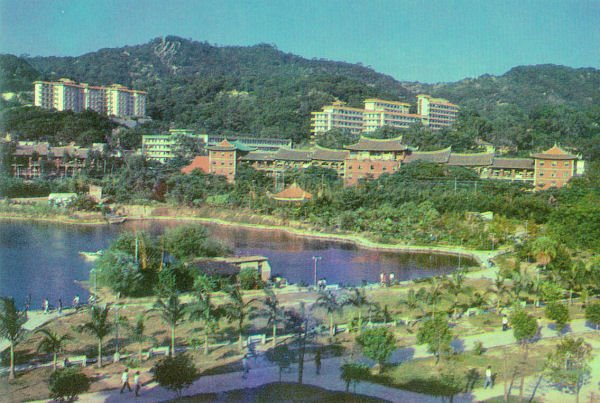
I just returned from 2.5 weeks in the Orient ... a week in Japan, doing biz meetings, going to a virtual worlds conference, seeing an awesome guitarist at a weird bar called BarTube, visiting an old friend, and hanging out w/ my son who is staying there for a month studying Japanese and playing Go ... a day or so in Seoul (visiting a humanoid robotics research group and a virtual pets company) ... a few days in Hong Kong giving a talk at WCCI's Human-Level AI session (on how to make a human-level NLP system by partly cheating, see the paper at http://novamente.net/papers) ... and a week in Xiamen, which is in China right across the water from Taiwan ... here's the beautifully situated Xiamen University ...


My friend Hugo de Garis (inventor of evolvable computing, prophet of the Artilect War and all around creative thinker)


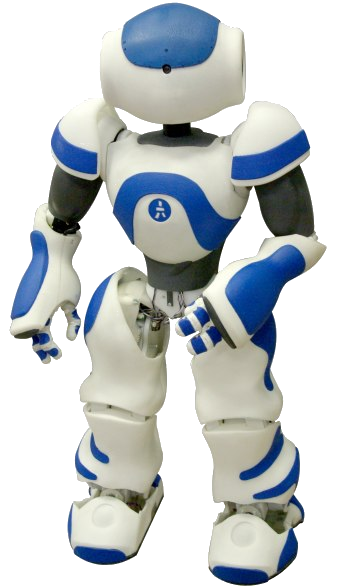
(there's me and Hugo and his wife) ... is now a prof at Xiamen University and he's pulling together a humanoid robotics team, whose goal is to spend 4 years making an intelligent computer brain for a Nao humanoid robot:

Hugo and I have been plotting a way to make a clever Nao via using his evolved neural nets for perception and action, and the OpenCog system for cognition and overall system control. The Xiamen folks seem to like the plan and we're discussing the possibility of me spending a couple months there each summer to collaborate, and them funding some students to work on the OpenCog side of the project. If someone follows ahead with the idea I've been selling, of integrating a robot simulator (like Gazebo) with a virtual world (like OpenSim), this could synergize really nicely with Novamente's AI-in-virtual-worlds stuff....

And Xiamen would be a very nice place to spend summers...


I've been fascinated by China since youth, probably due to my mother doing grad work in Chinese history and philosophy back then. She gave me a bunch of Chinese history books and stories and poetry to read, which made me fascinated with the culture. When I was 17, halfway thru my 3rd year of university, I applied for a scholarship to go to China for a year and do research relating non-well-founded sets (hypersets) to Buddhist cognitive philosophy. But the scholarship required me to know Chinese and I didn't, so I didn't go.... (I've never been able to put much energy into learning languages... too much other interesting stuff to study and think about ... and I find it hard to pick up languages via immersion because of my habit of not paying attention to what anyone is saying or doing around me ... so I'm rarely actually immersed in anything but my own thoughts ;-O ) ...

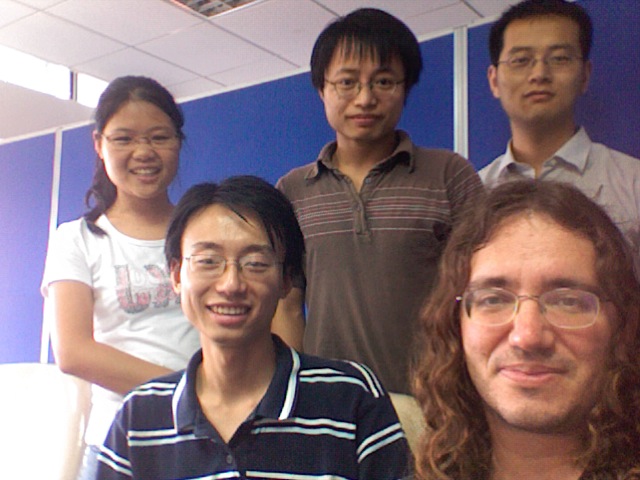
ANYWAYS ... I met F2F Novamente & OpenCog's Chinese contributors, which was very nice... here we have (back: Lian Ruiting, Guo Junfei, Chen Shuo, Rui Liu, me)


Very smart, interested, ambitious people!

Hugo is convinced that China is the country of the future and America is already obsolete. He foresees a coming century of reverse brain drain, where China recruits smart scientists and engineers from Western nations....

It might happen -- I don't rule it out. Of course, unlike Hugo, I think some sort of technological Singularity is very likely by mid-century and maybe sooner -- but let's ignore that for the moment ... talking just in conventional political/cultural terms, it's not obvious to me that he's right.

No doubt China has very many very smart and ambitious and hardworking people (like the ones pictured above!) ... but the cultural differences w/ the West are profound and I don't think any of us understands what they mean in terms of the future of science and engineering.

One observation I like to make is as follows. People talk about the knowledge economy ... where manual work has long been outsourced to 3rd world countries, leaving 1st world countries increasingly consumed w/ knowledge work.

And more and more so, the US becomes a pragmatic knowledge integration economy -- specialized knowledge like programming and science gets farmed out to 3rd world countries, but the task of integrating together various pieces of knowledge for practical purposes is still done in America. Even in Novamente, which is a damn international company, we do programming and science and project management overseas, but the figuring-out of what programming and science needs to be done to serve business goals, is largely done in the US. Because the US is where our customer companies are -- even if their work is largely done overseas, the high-level staff defining their vision are mostly here. The matching-up of technology and business, where Novamente is concerned, occurs mainly within the arena of US culture. (We do have overseas customers, but they are either run by Americans or following business models that closely copy American ones.)

The next step, I think, is the creativity economy. Even integrative knowledge will become commoditized. Creation of new ideas will be the LAST thing to get commoditized. But this is exactly where America excels. No nation on Earth fosters creativity as well as the USA. And for this reason, I'm not so sure that America's period of dramatic success is over. The more science and technology accelerate, the more critical creativity becomes -- and, lame as American culture and institutions are, they seem better than most alternatives at fostering wide-ranging creativity. (The only cultures I've known that seemed maybe more creativity-friendly were Australia, New Zealand and Hungary. But those are small places, population-wise.)

There is loads of creativity in China, for instance, on a personal level. Very creative people. But I'm not sure the culture fosters creativity in the way that US culture does. Oriental culture seems to favor obedience a lot more than US culture, and creativity is often not compatible with obedience.... The US is probably the most anarchic major developed country -- which has its downsides, especially for those below the poverty line in the US -- but, it seems that anarchy and creativity are inextricably entwined.

If China evolves a culture of creativity, then Hugo will be proved right and this will become the Chinese century ... and maybe the Singularity will get launched in China (hey, maybe it will get launched there anyway via Hugo's and my collaboration!!!)..... But that's a big "if", I suppose. Yet one feature of Chinese history is its tendency toward sudden, radical changes of one sort or another. Time will tell.

Anyway I look forward to returning to Xiamen and other parts of China when my schedule permits (hopefully for a couple months next summer, and a couple weeks in the fall or winter) ... there is a definite energy there that I don't find in developed countries these days, nor in 3rd world countries ... there is a feeling of "waking up" and progress that is exciting...

And, more importantly, there is a possibility of creating a thinking machine and doing other amazing technology projects there more rapidly than in other parts of the world, due to the availability of brilliant scientists and engineers at a relatively low cost (esp. outside the tier 1 cities). Whether or not China develops a culture of creativity allowing it to "own" the next century, there are loads of opportunities for international collaboration ... like what Hugo and I are trying to set up....

But anyway. Enough rambling. I've been sleep-deprived since returning from China, due to jet lag issues ... tonight I'll go to sleep "early" (i.e. maybe by 1AM) and hopefully actually get a full night of sleep.. (yah right...)


Thursday, June 05, 2008

Eureeka!! -- The Underlying Logic Unifying Quantum Theory and General Relativity, Revealed Over a Plate of Sour Fish Consumed Over South China

Eureeka!! -- The Underlying Logic Unifying Quantum Theory and General Relativity, Revealed Over a Plate of Sour Fish Consumed Over South China; Plus Long Digressions on Mark Twain, the Pathetic Woes of Middle Age and the Good Old Mongolian Skin-Peeler

[I wrote this post 2 weeks ago, but didn't get around to posting it due to being in China, with a slow Net connection..]

En route from Seoul to Hong Kong, exhausted from a 5 hour night's sleep following a 4 hour night's sleep, over-jazzed by too much strong coffee (which I rarely drink), stomach-sickened by ordering and consuming random dishes in a Korean restaurant via pointing at random hieroglyphs on the menu and hoping vainly for the best ... head full of Mark Twain's wacky biography which I just finished ... irrationally nervous due to having left my oldest son in Japan to tour around on his own for a week before his Japanese class in Kanazawa starts (yes, he's mature enough to handle himself ... and Japan is a damnably safe place, aside from the risk of spending all your money ... but even I the ultimate anarchist parent can't help a bit of worry) ... dulled almost but not quite to a stupor by a relentless series of software technology oriented business meetings (all with wonderful and interesting people, but still, there's only so much meeting I can take) ... I picked up Lee Smolin's book on quantum gravity, which I bought for my physician-cum-maverick-physics-theorist father-in-law years ago but never read myself ... and while reading a totally irrelevant passage and eating the oddly sour fish that passes for food on Korean Air, some very simple and obvious ideas popped into my mind, and I realized to my surprise that, via converging together several streams that have been tumbling through my head for years, I'd happened upon what appeared to be the correct probabilistic logic of unified quantum gravity.

I'm eager to write up this logic in a paper, but, I've promised myself not to undertake anything serious -- except tasks critical for Novamente as a business, or in order to fulfill obligations already incurred -- until the OpenCog Prime (http://www.opencog.org) wiki pages are done (maybe another 20-30 hours of work, but hours for concentrated writing/editing work are very hard to come by these days due to the combination of business obligations and ongoing research projects needing supervision and/or feedback).... But I'll indulge myself in a brief blog post on the topic as a stopgap - partly to ensure the idea doesn't escape from my mind tonight when I finally slip into the deep sleep my body's been craving for 72 hours or so....

Twain's bio was a fascinating read, by the way. Three things among many others struck me, viewing his life-story from a selfish view in terms of its potential lessons for my own life. One is the way he spent a load of his time on stuff other than writing -- business of various sorts, as well as lecturing, traveling and so forth. But these "distractions" didn't seem to detract from his productivity as a writer as much as I would have thought -- they filled his head with stimulation and ideas, and no doubt made his writing more interesting than if he'd just sat home writing all day. Second is the romance he found in business pursuits ... which reminded me a bit of Rimbaud, who gave up poetry as a very young man after too few years as a writer, and wasted his twenties chasing African gold, ultimately dying from poisoning attained via wearing gold under his undies to hide it from thieves. Rimbaud, due to his premature death among other issues, failed to transform his digressive life experiences into art. I can see in my own psychology the excitement that the business world held for these people: it does stimulate parts of the mind that creative art and science don't touch. Finally I'm struck by the amount of real trash literature Twain produced. I'm reminded of Danilo Kis's (a truly great Serbian writer -- thx to Predrag Janicic for waking me up to him) comment that he didn't write his complete works, only his selected works. Twain was not like that. Twain's best work was awesome, his worst work was terrible. He could have omitted a good 50% of his production and his legacy would be greater not less. Philip K. Dick had the same property: there's Ubik ... and then there's Dr. Futurity.... The lesson for me is, I suppose, not to worry too much about spending time on apparently digressive pursuits (like writing this blog post, um) -- so long as they're feeding the creative engine one way or another -- and given the limited time I have for creative pursuits, to try hard to be more like Kis than Twain or Dick, and filter out crappier works before I take the time to produce them.

Another striking thing about Twain was the way he foresaw the power of machinery to alleviate human suffering. A lesson that seems obvious these days but was surprisingly poorly understood in his times, even though the industrial revolution was in full swing and new mechanical inventions of all sorts were pouring out of human minds at an amazing rate. If you haven't read it, his Connecticut Yankee in King Arthur's Court -- arguably the first American SF novel -- is a hilarious and deeply insightful premonition of the promise and peril of advanced technology. As a time travel fable, it's got Back to the Future beat by a long shot, without need of paradoxical absurdities beyond those intrinsic to human nature.

And now... what about quantum gravity...

Three threads need to be drawn together, into a single mathematical formalism. But there really seems no obstacle to doing so. (Except time of course, which is a distressingly rare commodity for me these days. Must confess to a bit of jealousy of my son as he wandered off from Tokyo to Kyoto, with no specific plan for spending his days, other than to amuse himself. I never intended to accumulate so many obligations -- keep companies running, organize conferences, pay other peoples' college tuition, close a mortgage, finish a book, pay child support each month, drive the kids to and from school, blah blah blah blah blah ... I once actually thought I'd live the life of the "free and easy wanderer" from the Chuang Tzu (on my mind as the flight I'm on approaches China), or maybe of Paul Erdos who freeloaded off one friend after another as he spent his life journeying around the world doing mathematics and taking drugs ... I never envisioned taking on all this responsibility for other people (kids, wife, ex-wife) and organizations (companies, non-profits, egads!) ... yet it's all wonderful, interesting stuff ... people and ideas I really care about ... so I'd really be an ass to complain ... it's a fantastic time to be alive ... yet not quite as fantastic as a few decades hence will likely be, when minds will be far more fully liberated from the horrifying/stultifying constraints of legacy human physiology ... but, well, anyway...)

Quantum gravity!

Thread one was invented by Saul Youssef, and I've written about it before. Check out the lovely bibliography he's assembled at 


Brilliant, brilliant man. A hero of our time! Someone give that man a muffin!!

The observation here is that if you're willing to take the step of assuming probabilities are complex rather than real numbers, the basic rules of quantum theory fall right out. This is one of those things that seems shocking and weird at first, and then seems tremendously obvious after you read through the math. Three cheers for Saul Youssef!!

Thread two is something I came up with a couple years ago, and wrote up in a paper which I'm in the middle of submitting for publication. I sent the paper to a journal and they sent it back asking me to provide names and mailing addresses of eight referees able to review the paper. I've been lagging on that task along with a huge amount of other stupid paperwork that's accumulated during the last N years. I guess the editor couldn't think of anyone to send it to. The idea, anyway, is infinite order probability.

An ordinary probability is a probability of an event. A probability distribution is a function that assigns a probability to each one of a set of mutually exclusive outcomes of some event (the different values assigned to different exclusive outcomes must sum to one). A second-order probability is a probability distribution over probability distributions ... it's a function that assigns a probability to each one of a set of probability distributions. A third-order probability ... etc.

An infinite-order probability is a function that assigns a probability to each one of a set of infinite-order probability distributions. Sounds odd, but it's a mathematically consistent idea, as I showed in my paper. I also showed that these oddball entities are closely related to some much more familiar and intuitive mathematical entities, Markov matrices.

The third thread is causal networks. A foundational notion in general relativity is causality. The causal network of events, in relativity, tells you for any pair (A, B) of events, which ones have the property that A is causal for B. This has to do with the finitude of the speed of light: if A and B are too close in time and too distant in space, there may be no way for A and B to causally affect each other.

If A and B are not causally related, there may still be some event C so that C is causal for both A and B. In that case we may say that, probabilistically speaking, A and B are independent conditional on C. That is,


P(A & B | C) = P(A | C) P(B |C)


The causal network gives us a set of independence assumptions on the space of events.

General relativity is in essence a dynamic on causal networks: it tells you how a causal network at one time (plus some extra information) gives rise to a different, related causal network at a subsequent time.

Finally let's reflect on what Smolin (see Three Roads to Quantum Gravity) calls the "strong holographic principle." His reasoning for this principle is subtle and involves the Bekenstein bound and related results, which state that all the information about the interior of some physical region, may actually be thought of as being contained on the surface of that regions. (He explains this better than I could, so I'll just refer you to his book.)

What the principle says is: a la Nietzsche, there are only surfaces. Re-read Nietzsche's Twilight of the Idols and you'll see that he presaged quantum gravity here, in a similar way to how he presaged quantum theory proper in his vision (in The Will to Power) of the universe as composed of a dancing swarm of discrete interacting quanta. Kant posited phenomena and noumena, Nietzsche saw only noumena. Smolin also. Smolin views the universe as a collection of surfaces, each one defined as a relationship among other surfaces. Put in words like this, it sounds mystical and fuzzy, but there's math to back it up -- the words just hint at the mathematical reality.

But is each of these Smolin surfaces definitively known? No. Each one is probabilistically known. And if each of these surfaces is to be thought of as a relationship between other surfaces, then this means each of these surfaces is most directly modeled as a hyperset (see my prior blog posts on these mathematical constructs). (This is not how Smolin models things mathematically, but I doubt he'd be opposed, as he's used equally recondite math structures such as topoi.) So these surfaces should be modeled as probabilistic hypersets -- aka infinite-order probability distributions.

But what kinds of probabilities should be involved in these distributions? Clearly, Youssef has taught us, these should be complex probability distros -- or in my variation, infinite-order complex probability distributions.

The inescapable conclusion is: The physical universe is a dynamically evolving causal network defined on an infinite-order complex probability distribution.

You read it first here, folks.. ;-O

Or, to put it a bit more conservatively: A useful, perhaps critical language for modeling quantum gravity phenomena is the logic of causal networks on infinite-order complex probability distributions.

There are fun connections here with the psychology of self-awareness and free will, as I've discussed in a couple previous blog posts (follow the links). According to those blog posts, a good way to model reflective awareness would be using infinite-order real probability distributions; and a good way to model will would be using causal networks on these distributions. What quantum theory introduces is the complex-number probability aspect, which makes everything counterintuitive and weird.

I hope I can really find time -- amidst the manifold obligations of middle age plus the not incidental life-task of creating superhuman AI, plus other distractions like bioinformatics and fiction and music and what-not ... and family and the occasional personal entertainment -- to write these ideas up carefully, because I really do think they have deep potential.

There seem to be more connections lurking here: the logic of causal networks seems somehow inescapably tied up with Clifford algebras, providing a tie-in with my algebra of multi-boundary forms (my only publication in a physics journal so far, but it's really a math paper). Presumably one can go from causality somehow straight to discrete Clifford algebras using some kind of axiomatic derivation, and from there to the various beautiful algebraic symmetries underlying modern physics ... Gell-Mann's "Eightfold Path" and its kin ... but anyway, the flight's about to land and the stewardess wants me to put away my laptop, so the blog post is gonna end .. I'll post it online when I get back to the hotel assuming there's functional internet there ... the inimitable Yan King Yin (famous on various AI email lists) is picking me up at the airport and I'm curious to meet him, although I'm so worn out I'm not sure I'll be lucid enough to milk the occasion's potential for lively AI discussions....

How about the bloody Yverse (see previous blog post on this)? Each Smolin surface ... each relation in the network of interdefining hyperrelations ... defines its own multiverse: a quantum multiverse relative to its own perspective. The network of surfaces (aka relationships) is then a Yverse. QED.

Another day, another dozen digressions ... it's SOOOOO tempting to take a few days and formalize the logic of causal nets over complex infinite-order distros, but instead (inbetween biz meetings and AI research meetings and conference speeches and meals with AI colleagues) I'll spend my "spare" hours in the next few weeks on the OpenCogPrime documents ... a very tedious matter of taking about 50 wiki pages from the Novamente wiki site and editing them down into OpenCogPrime rather than Novamente Cognition Engine pages... yecch...

(Any wealthy patrons out there want to hire me a secretary, a housecleaner and a scientific assistant? I can't promise the Singularity will be accelerated by a few years but it's a definite possibility. For sure a lot more fascinating math, art and science would be generated were I to be thus endowed. (And, getting back to Twain, I wonder what additional great works he would have produced if some of his rich friends had decided to fund him, sparing him the financial anxiety that led him to waste years of his life on various harebrained business schemes. Yeah, they provided grist for his creative mill ... but there's such a thing as too much grist and not enough time to mill.) But I can't complain too much (er, OK, wait, I guess I am...) ... whenever I get TOO frustrated at the realization that 50% of my really good ideas and creations will remain forever unarticulated or un-worked-out-in-detail because I've failed to be born rich or become rich (so far), I remind myself of my favorite Haruki Murakami character, the Mongolian Skin-Peeler ... a World War II torture artist who tortured Chinese prisoners of war by slowly peeling their skin off ... as I see Ulaanbaator on the video screen of the plane as it approaches Hong Kong (haha, I'm a bad boy and failed to shut off my laptop when instructed ... how very non-Oriental of me!!) it's hard for me not to feel thankful that I'm not one of his victims ... I've got my epidermis attached to my dermis, woo hoo! ... and I at least have time to work out a nontrivial percentage of the cool ideas and creations that course through my overheated brain...)

(While you're at it, imaginary patron, recruiting Novamente LLC a CEO with lots of game or virtual world industry experience would be nice. I think I'm doing a decent job as CEO, with help from Bruce and Cassio and Wendy and my other wonderful colleagues, but it would be nice to have a sufficiently complete management team that I could spend 80% of my Novamente-time on science rather than business. And you may as well recruit us a kick-ass project manager too, so Cassio can help me out with research and retire from project management. (Ok, dream on, Ben.... And remember the Mongolian Skin-Peeler....). And while you're at it, throw in maybe $1M per year so that I can actually fund a team of kick-ass programmers to build a thinking machine ... in case you haven't heard I have a pretty detailed and well-argued design for one, but it's getting built bloody fucking slowly due to lack of funding, and because it's not the sort of thing where partial progress yields exciting incremental results, any more than building 30% of a human brain would yield a 30% functional human... but I dididididididigress ;_)

(I think my wife is really, really tired of hearing about the Mongolian Skin-Peeler. He seems to occupy an unjustifiably prominent role in my emotional topography. Read The Wind-Up Bird Chronicle.)

Mark Twain, I add, would have been a hell of a blogger; far more entertaining than me. He wrote a dozen letters each day back then in the pre-digital dark ages.

Time to get off the plane.

Friday, May 02, 2008

Open-Source Robots + Robot Simulators + Virtual Worlds + AI = ???

I’ve been reading up on the iCub open-source humanoid robot lately, and I think it’s pretty exciting. Given what open source has done for Web browsers, bioinformatics tools and other sorts of software, the possibility of harnessing the same development methodology for robot hardware and software development seems almost irresistably exciting.

I’m no roboticist, but I do know something about the AI software that robots need to understand the world and act in it – and I’ve been doing a lot of work lately on the use of AI to control simulated agents in virtual worlds. In this vein, this blog entry contains some follow-up thoughts about the possibility of building connections between the iCub and various other relevant open-source software systems relevant to AI and virtual worlds.

For starters: What if someone made a detailed simulation of iCub in Gazebo, an open-source 3D robot simulation platform? Then folks around the world could experiment with iCub without even building a robot, simply via writing software and experimenting with the simulation. Experiments with other robots and Gazebo have shown that the simulation generally agrees very closely with real-world robotic experience.

And what if someone integrated Gazebo with OpenSim, the up-and-coming open-source virtual-world platform (which uses an improved version of Second Life’s user interface, but features a more sophisticatedly architected and flexible back end, and best of all it’s free)?

Furthermore, work is underway to integrate OpenSim with OpenCog, an open-source AI platform aimed at advanced machine cognition (yes, I’m one of the organizers of OpenCog); and OpenSim could similarly be integrated with OpenCyc, OpenNARS, and a host of other existing open-source AI platforms. Throngs of diversely customized, simulated iCubs controlled by various AI algorithms could mill around OpenSim, interacting with human-controlled avatars in the simulated world, learning and sharing their knowledge with each other. The behaviors and knowledge learned by the robots in the virtual world could then be transferred immediately back to their physically embodied brethren.

What stands between us and this vision is “just” some software integration work ... but of course, this kind of work isn’t easy and takes time and expertise. For various economic and cultural reasons, this sort of work has not been favored by any of the world’s major R&D funding sources – but the open-source approach seems to have increasingly high odds of getting it done. It seems at least plausible that iCub won’t go the way of OpenPINO and other prior attempts at open-source robotics, and will instead combine with other open-source initiatives to form a key part of a broadly-accepted, dynamically evolving platform for exploring physical and virtual humanoid robotics.

Sunday, April 06, 2008

Artificial Wisdom (... episodic memory, general intelligence, the Tao of John Coltrane, and so forth)

Every now and then, someone suggests to me that, alongside the pursuit of Artificial Intelligence, we should also be pursuing "Artificial Wisdom."

I always figured the "artificial wisdom" idea was probably just a bunch of useless English-language wordplay -- but one night last week, while watching Idiocracy with the kids for the second time (great movie exploring a non-Singularity-based future by the way ... highly recommend it!), I spent a while surfing the Web on my laptop refreshing my memory on how others have construed the "wisdom" concept and musing on what it might mean for AI.

Surprisingly enough, this led in some moderately interesting directions -- nothing revolutionary, but enough to justify the couple hours spent musing about it (and another 90 minutes or so synthesizing and writing up my glorious conclusions).

My main conclusion was a perspective in which wisdom is viewed as one of three core aspects of intelligence, associated with three distinct types of memory:

  • cleverness, associated with declarative memory (and the ability to manipulate abstract, certain or uncertain declarative knowledge)
  • skillfulness, associated with procedural memory (and the ability to effectively learn and adapt new procedures based on experience)
  • wisdom, associated with episodic memory (and insightful drawing of large-scale conclusions therefrom)

This being a blog post, though, rather than just presenting my conclusion, I'll start out by recounting some of the winding and mostly irrelevant path that led me there ;-)

Classical Conceptions of Wisdom

I started out with the dictionary, and as usual found it close to useless....

A typical dictionary definition of "wisdom," which is not a heck of a lot of help, is from Wiktionary, which tells us that

wisdom (plural wisdoms)

means

  1. An element of personal character that enables one to distinguish the wise from the unwise.
  2. A piece of wise advice.
  3. The discretionary use of knowledge for the greatest good.
  4. The ability to apply relevant knowledge in an insightful way, especially to different situations from that in which the knowledge was gained.
  5. The ability to make a decision based on the combination of knowledge, experience, and intuitive understanding.
  6. (theology) The ability to know and apply spiritual truths.
and furthermore that

wise

means

Showing good judgement or the benefit of experience.

Hoo haw.

These definitions don't give us any particularly interesting way of distinguishing "wisdom" from "intelligence." Essentially they define wisdom as either intelligence, spiritual insight, or the application of intelligence for ethical ends. Nothing new here.

Wikipedia is slightly more useful (but only slightly). Firstly it notes that

A standard philosophical, (philos-sophia: literally "lover of wisdom"), definition says that wisdom consists of making the best use of available knowledge.

It then notes some psychological research demonstrating that in popular culture, wisdom is considered as different from intelligence. Psychological researchers are quoted as saying that though "there is an overlap of the implicit theory of wisdom with intelligence, perceptiveness, spirituality and shrewdness, it is evident that wisdom is a distinct term and not a composite of other terms."

More interestingly, Wikipedia notes, Erik Erikson and other psychologists have argued that it is, in large part, the imminence of death that gives older human beings wisdom.

The knowledge of imminent death is seen as focusing the mind on concerns beyond its own individual well-being and survival, thus inducing a broader scope of understanding and an identification with the world at large, which are associated with the concept of wisdom.

This is interesting from a transhumanist perspective in that it suggests that the death of death would be the death of wisdom! I have seen some evidence for that in the incredible, shallow-minded selfishness of a certain subset of the transhumanist community -- people who are dead-set on having their own selves live forever, without any real thought as to why this might be valuable or what this might mean in a larger perspective. But of course, I don't really think death is the only or ultimate source of wisdom, though in a human context I can believe it's one of the main forces nudging us toward wisdom.

Paul Graham on Wisdom

One of the more interesting theories of wisdom I've run across (I found it a while ago for some random reason I've forgotten, and dug it up again last week) came from a contemporary blogger, Paul Graham:

http://paulgraham.com/wisdom.html

who distinguishes wisdom from intelligence in the following way:


"Wise" and "smart" are both ways of saying someone knows what to do. The difference is that "wise" means one has a high average outcome across all situations, and "smart" means one does spectacularly well in a few.

This explanation also suggests why wisdom is such an elusive concept: there's no such thing. "Wise" means something—that one is on average good at making the right choice. But giving the name "wisdom" to the supposed quality that enables one to do that doesn't mean such a thing exists. To the extent "wisdom" means anything, it refers to a grab-bag of qualities as various as self-discipline, experience, and empathy

Graham considers wisdom as partly a kind of de-biasing and cleansing of the mind, a notion that has some resonance with the modern notion of "Bayesian calibration" of the mind:

Recipes for wisdom, particularly ancient ones, tend to have a remedial character. To achieve wisdom one must cut away all the debris that fills one's head on emergence from childhood, leaving only the important stuff. Both self-control and experience have this effect: to eliminate the random biases that come from your own nature and from the circumstances of your upbringing respectively. That's not all wisdom is, but it's a large part of it. Much of what's in the sage's head is also in the head of every twelve year old. The difference is that in the head of the twelve year old it's mixed together with a lot of random junk.

Provocatively, Graham also posits that intelligence is quite different from wisdom, in that it has to do with accentuating rather than avoiding biases:

The path to intelligence seems to be through working on hard problems. You develop intelligence as you might develop muscles, through exercise. But there can't be too much compulsion here. No amount of discipline can replace genuine curiosity. So cultivating intelligence seems to be a matter of identifying some bias in one's character -— some tendency to be interested in certain types of things—- and nurturing it. Instead of obliterating your idiosyncrasies in an effort to make yourself a neutral vessel for the truth, you select one and try to grow it from a seedling into a tree.

To avoid confusion, from here on I'll sometimes refer to Graham's interpretation of these concepts as Graham-style wisdom and Graham-style intelligence, respectively.

There is an unclarity in Graham's essay as to the extent to which he thinks the kind of focusing and bias-accentuation that's part of Graham-style intelligence has to involve irrationality. My own view is that Graham-style intelligence definitely does NOT require an individual to be irrational, in the sense of making suboptimal judgments about a particular problem given the resources devoted to thinking about the problem. However, a finite system in a complex environment is always going to be irrational to some measure, due to not having enough resources to make a fully analysis of any complex situation. To the extent that Graham-style intelligence involves heavy focus on some particular set of topic areas, it's going to drain resources from other areas, thus making the mind less intelligent regarding these other areas.

So, in Graham's view, intelligence has to do with focusing loads of resources on processing in a handful of narrow domains that match one's innate biases, whereas wisdom has to do with evenly distributing processing across all the different domains in one's environment.

Along these lines Graham also notes (correctly, I think) that:

The wise are all much alike in their wisdom, but very smart people tend to be smart in distinctive ways.

As Graham conceives it, wisdom is basically equivalent to general intelligence: it's intelligence averaged across a variety of situations. In mathematics there exist various sorts of averages, some of which weight extreme values more heavily than others (these are p'th power averages). Graham's view would be that "wisdom" and "intelligence" are both estimates of general intelligence (defined as intelligence averaged over different domains/tasks), but with different sorts of averaging: in the case of intelligence, an averaging that pays especial attention to extremes (say a p-power average with p=5, or whatever); and in the case of wisdom, a more typical arithmetic averaging.

This is all sort of nice, but (as will become clear as the essay unfolds) I don't really think it gets at the crux of the matter.


Wisdom Goes Beyond the Individual

Another interesting perspective (that I also think doesn't get at the crux of the matter) is given in the paper "Meaning generation and artificial wisdom" with abstract

We propose an interpretation of wisdom in terms of meaning generation in social groups. Sapient agents are able to generate useful meanings for other agents beyond their own capability of generation of self-meanings. This makes sapient agents specially valuable entities in agent societies because they provide interagent reliable third-person meaning generation that provides some functional redundancy that contributes to enhance individual and social robustness and global performance.

Here wisdom is identified with the ability to generate meaning in the social group, going beyond meaning that is perceptible by the individual doing the meaning-generating. This harks back to Erikson's understanding of wisdom as related to identification with the world at large, beyond the mind/body.

This view also reminds me vaguely of Aldous Huxley's Perennial Philosophy, an attempt to distill the "wisdom teachings" of all the world's religions. In the Perennial Philosophy, wisdom teaches that the individual self is an illusion and all of us are one with the universe (and yet in a sense still distinct and individual.)

Mulling over all this, none of it really satisfied me. Of course, a folks concept like "wisdom" can't be expected to have a crisp and sensible formalistic definition ... but it still seemed to me that all the attempts at systematization and formalization I'd read about were missing some really essential aspects of the folk concept.

Wisdom, Cleverness and Skillfulness

And so, I came up with a totally different idea....

After a fair bit of musing, my mind kept drifting to the familiar distinction between declarative, procedural and episodic memory (drawn from textbook cognitive psych).

Remember:

  • Declarative knowledge = knowledge of facts, conjectures, hypotheses (abstract or concrete)
  • Procedural knowledge = knowledge of how to do things (could be physical, mental, social, etc.)
  • Episodic knowledge = knowledge of stories that have occurred in the history of intelligent beings (oneself, others one knows, others one has heard about,...)

One interesting thought that popped into my head is: The concept of wisdom, in its folk-psychology sense, has a lot to do with the ability to solve problems that are heavily dependent on context, using intuition that's based on large-scale analysis of one's episodic-memory store.

Or, less geekily: Wisdom consists of making intelligent use of experience.

A subtlety here is that this need not be one's own experience. Direct experience may be the best way to acquire wisdom (and surely this is part of the reason that wisdom is commonly associated with age) but some rare folks are remarkably gifted at absorbing wisdom from the experience of others -- absorbed via observation, via reading, or conversation, or whatever.

More broadly, this train of thought leads me to a sort of fundamental trinity of aspects of intelligence: cleverness, skillfulness and wisdom.

There's cleverness, which is the ability to appropriately manipulate, create and absorb declarative knowledge toward one's goals. This declarative knowledge may be abstract, or it may be concrete facts. Declarative knowledge is largely symbolic in nature, and cleverness is largely founded on adeptness at symbol-manipulation.

There's skillfulness, which is the ability to effectively do stuff in service of one's goals. This covers physical skills but also highly abstract mental skills like writing an essay, proving a theorem, or closing a business deal.

In some domains skillfulness can exist in the total absence of cleverness. The vast majority of shred metal guitarists would seem to fit in this category (to choose a somewhat random example based on what's playing in my headphones at the moment). These guys are so damn skilled, yet there's not much adept manipulation of meaning in their solos, or compositions. Compare the typical shred guitarist to Yngwie Malmsteen or Buckethead, who are also massively skilled (and in similar ways) -- but who are also highly clever in their symbolic manipulation of the abstract patterns characterizing the concrete sonic forms they're so skilled at producing.

In other domains, it's really hard for cleverness and skillfulness to emerge in any way except exquisitely intercombined. Mathematics is an example. Procedural knowledge at doing proofs is needed for fully understanding complex proofs -- because so many steps are left out in proofs as typically written down, if you don't know how to do proofs, you won't be able to fill in all the gaps in your head when you read a proof, so you'll never get more than a general understanding. On the other hand, it's even more obvious that deep declarative understanding and manipulation-ability regarding mathematical content is necessary to do mathematical proofs. Math is a domain where procedural and declarative intelligence have got to work in extremely tight synergy.

Finally, there's wisdom, which as I'm conceiving it here is the ability to intelligently draw conclusions from a vast repository of data regarding specific situations.

Human minds tend to organize data regarding specific situations using story-like, "narrative" structure, so that in human practice, wisdom often takes the form of the ability to mine appropriate abstract patterns from a vast pool of remembered stories.

Of course, the operation of human episodic memory is largely constructive -- we don't actually grab experiential data out of some sort of neurological database; rather, we synthesize stories from fragmentary images, stories, and such. Wisdom is about synthesizing appropriate stories from large databases of partially-remembered, ambiguous, fractional stories -- and then, as appropriate, using these stories to guide the creation of declarative or procedural knowledge.

In mathematics, wisdom is closely related to what's called "mathematical maturity" ... the general sense of how mathematics is done. Mathematical maturity guides the mind to interesting problems and interesting concepts ... and helps you choose an overall proof strategy (whereas it's cleverness and skillfulness that help you carry out the proof).

The transition from {cleverness + skillfulness} to wisdom in music is epitomized to me by the mid-to-late John Coltrane ... the Coltrane of "My Favorite Things" and "A Love Supreme." These are the solos of a man who has listened so much and played so much that he's disassembled thousands of different musical narratives and reassembled them to tell different kinds of stories, like no one ever told before. So much richer than the merely clever, skillful and emotionally moving solos of the early Coltrane. Certain works of great art manage to be intensely personal and dramatically universal at the same time, and
this often results from wisdom in the sense I'm defining it here.

Note that a mature mathematician or a world-changing jazz soloist need not be "wise" in the sense of a Taoist sage. The classical conception of wisdom has to do with making intelligent judgments based on large stores of experience in everyday human life. In the old days this was pretty much the only experience there was -- everyday human life plus various shamanic and psychedelic experiences.... But now the human world has become far more specialized, and it's possible to have a specialized wisdom, because it's possible to have a huge and rich store of episodic knowledge that's restricted to some special domain, like music or mathematics, or even a sufficiently complex game like Go or chess.

This vision of wisdom would seem to contradict Graham's, cited above -- he views wisdom as related to the ability to achieve goals over a broad variety of domains, in contract to intelligence which he conceives as a more narrowly domain-specialized intelligence.

But I don't think the contradiction is total.

I think that within a sufficiently rich and complex domain, one requires wisdom as I've defined it in order to achieve a really high level of intelligence. Learning skills and manipulating symbols is not enough. Direct and intelligent mining of massive experience-stores is needed.

I also think that wisdom, even if achieved initially and primarily within a certain domain, has a striking power to transcend domains. There are a lot of universal patterns among large stores of stories, no matter what the domain.

But even if the wisdom achieved by a great mathematician or chess player or jazz soloist helps that person to intuitively understand the way things work in other domains, this won't necessarily lead them to practical greatness in these other domains -- great achievement seems to require a synthesis of wisdom with either cleverness or skillfulness, and in some domains (like math or jazz improvisation) all three.

Defined-Problem versus Contextual Intelligence

Next, what does all this have to do with artificial intelligence?

One of the lessons learned in the last few decades of AI practice is that there is a pretty big difference between:

  1. Defined-problem intelligence: Problem-solving that occurs "after a crisply-defined problem statement has been identified", versus
  2. Contextual intelligence: problem-solving that is mainly concerned with interpreting general goals in the context of a complex situation, and, "figuring out what the context-specific problem is, in the first place" -- i.e. figuring out what crisply-defined problem, if solved in the relevant context, is likely to work toward the general goals at hand

I think this might be a more useful and more precise distinction than the "narrow AI" versus "general AI" distinction that I've often made before. It's ultimately getting at the same thing, but it's putting the point in a better way, I think.

What's narrow about "narrow AI" systems like chess-playing programs and medical diagnostic expert systems isn't merely that they're focused on specific, narrow domains. It's the fact that they operate based on defined-problem intelligence. It happens, though, that in some sufficiently specialized domains, defined-problem intelligence is enough to yield ass-kicking performance. In other domains it's not -- because in these other domains, figuring out what the problem is, is basically the problem.

I suggest that defined-problem intelligence is focused on declarative and procedural knowledge: i.e. it consists of cleverness or skillfulness or some combination thereof.

Logical reasoning systems, for example, are focused on declarative knowledge, and possess in some cases great facility at manipulating declarative knowledge.

Evolutionary learning systems and neural nets, on the other hand, are mainly focused on procedural knowledge -- on learning how to do stuff, without need for symbolic representations or symbol manipulations.

On the other hand: Contextual intelligence, I suggest, is a matter of knowing how to synthesize declarative and procedural knowledge, that representing problem-statements and problem-solutions, out of the combination of general goals and real-world situations.

I suggest that powerful contextual intelligence always relies upon powerful use of episodic memory, and associated mechanisms for storing, accessing, manipulating and analyzing sets of stories.

Or, briefly getting less geeky again: contextual intelligence requires wisdom.

Not at the level of the Taoist sage, John Coltrane or Riemann ... but at a way higher level than possessed by any currently operational AI system.

Note that defined-problem intelligence may sometimes draw on a wide body of background knowledge -- but it uses this background knowledge in a manner constrained by certain well-defined declarative propositions, or practical constraints on procedure-learning. It uses the background knowledge in a manner that doesn't require the background knowledge to be organized or accessed episodically -- rather, it uses background knowledge as a set of declarative facts, or data items, or constraints on actions, or procedures for doing specific things in specific types of situations.

"How to make a lot of money in Russia" is a problem that requires intense contextual as well as defined-problem intelligence. Whereas, "how to make a lot of money by trading oil futures on the Russian stock exchange" is more heavily weighted toward calculational intelligence, though it could be approached in a contextual-intelligence-heavy manner as well.

For instance, in the domain of bioinformatics, figuring out a rule that can diagnose a disease based on a gene expression microarray dataset, is a well-defined problem -- a problem that can be solved via focusing strictly on a small set of reasonably well-encapsulated information items. Declarative and/or procedural focused AI works well here ... much better than human intelligence.

On the other hand, figuring out which datasets are likely to be reliable, and figuring out how to normalize these datasets in a reasonable way based on the experimental apparatus described in the associated research paper, are tasks that require much more understanding of context, more milking of subtle patterns in episodic memory. I.e., I'm suggesting, more wisdom.

In the current practice of bioinformatic data analysis, human wisdom is needed to craft well-defined problems to feed into the superior (in this domain) declarative and procedural intelligence of narrow-AI bioinformatic data-analysis systems like the ones we've created at Biomind LLC.

Doing Time in the Universal Mind

Getting back to some of the ideas introduced at the start of this essay ... it seems all this ties in moderately closely with Erikson's definition and the Perennial Philosophy definition of "wisdom."

These definitions conceive wisdom as related to an understanding of life situations in a broader context than that of the individual body and mind. Wisdom as these thinkers conceive it, is a higher level of contextual intelligence than average humans display -- an ability to conceive daily situations in a broader-than-usual context.

This corresponds, really, to relying on a kind of collective episodic memory store, rather than just the episodic memory store corresponding to one's own life. By the time one is old, one is reviewing a longer life, and reviewing the past and future lives of one's children and grandchildren, and thinking about the whole scope of stories all these people may be involved in. A much richer contextuality.

Another ingredient of the Perennial Philosophy notion of wisdom is self-understanding, and I think that ties in here very closely too. One's own self is always part of the context, and to carry out really deep contextual understanding or problem-solving, one needs to appreciate how one's own history, knowledge and biases are affecting the situation and affecting one's own judgments. Powerful contextual intelligence -- unlike powerful calculational intelligence -- requires deep and broad self-understanding.

Wrapping Up

Sooo ... if we conceive wisdom as contextual intelligence powered by rich analysis of episodic memory, then it is clear that wisdom is a key aspect of general intelligence -- and is precisely the aspect that the AI research field has most abjectly ignored to date.

And it is also clear that ethical judgment is richly bound up with wisdom, as here conceived. Ethical judgment, in real life, is all about contextual understanding. It's not about following logical principles of ethics -- even when such principles are agreed-upon, real-life application always comes down to tricky context-specific intuitive judgments. Which comes down to understanding a vast pool of different situations, different episodes, that have existed in the lives of different human being and groups.

Defined-problem intelligence can be useful for ethical judgments. For instance in cases where scarce resources need to be divided fairly among a large number of parties with complex interrelationships and constraints, one has a well-defined problem of figuring out the optimally ethical balance, or a reasonable approximation thereof. But this actually seems an exceptional case, and the default case of ethical judgment seems to be to rely much more heavily on contextual than defined-problem intelligence.

Just to be clear: I'm not claiming that the conception of "wisdom" I've outlined here thoroughly captures all aspects of the natural-language/folk-psychology term "wisdom." Like "mind", "intelligence" and so forth, "wisdom" is a fuzzy term that amalgamates various different overlapping meanings ... it's not the kind of thing that CAN be crisply defined and analyzed once and for all.

What I hope to have done is to extract from the folks concept of wisdom some more precise, interesting and productive ideas, that closely relate to this folk concept but don't pretend to exhaust it.

In short...

  • General intelligence = defined-problem intelligence + contextual (problem-defining) intelligence
  • Calculational intelligence = cleverness (declarative intelligence) + skillfulness (procedural intelligence)
  • Contextual intelligence = in the human context, highly reliant on large-scale analysis of episodic memory
  • Wisdom = interestingly interpreted as contextual intelligence
  • Ethics = heavily reliant on wisdom

In this view, not surprisingly, the pursuit of Artificial Wisdom emerges as a subtask of the pursuit of Artificial General Intelligence. But what's interesting is it emerges as a complementary subtask to the one that most of the AI community is working on at the moment -- narrow-AI, or artificial defined-problem intelligence.

There is a bit of work in the AI community on narrative and story understanding. But most of this work seems, well, overly artificial. It has to do with formalistic systems for representing story structure. That is just not how we do things, in our human minds, and I suspect it's not an effective path at all.

I don't at the moment know any way to give an AGI system a rich understanding of episodes in the world than to actually embed it in the world and let is learn via experiencing. Virtual worlds may be a great start, given the amount of rich social interaction now occurring therein.

Thus I conclude that an excessive focus on narrow-AI research is, well, un-wise ;-)

And physically or virtually embodied AGI may potentially be a wise approach...

And I return again to the apparent wisdom of integrative AI approaches. Cleverness, skillfulness and wisdom are, I suggest, separate aspects of intelligence, which are naturally implemented in an AI system as separate modules -- but modules which must be architected for close inter-operation, because the real crux of general intelligence is the synergetic fusion of the three.