My goal in this blog is to convince you to read Damien Broderick's book Outside the Gates of Science: Why It's Time for the Paranormal to Come in From the Cold.
Reviewing a host of research done by others over many decades, the book makes a remarkably and excitingly strong case that psi phenomena are worthy of intensive further investigation....
Let me explain why I'm so excited by Broderick's work.
Having grown up on SF, and being a generally open-minded person but also mathematician/scientist with a strong rationalist and empiricist bent, I've never quite known what to make of psi. (Following Broderick, I'm using "psi" as an umbrella term for ESP, precognition, psychokinesis, and the familiar array of suspects...).
Broderick's book is the first I've read that rationally, scientifically, even-handedly and maturely, reviews what it makes sense to think about psi given the available evidence.
(A quick word on my science background, for those who don't know me and may be new to this blog: I have a math PhD and although my main research areas are AI and cognitive science, I've also spent a lot of time working on empirical biological science as a data analyst. I was a professor for a 8 years but have been doing research in the software industry for the last decade.)
My basic attitude on psi has always been curious but ambivalent. One way to summarize it would be via the following three points....
First: Psi seems, on the face of it, is not wildly scientifically implausible after the fashion of, say, perpetual motion machines built out of wheels and pulleys and spinning chanbers filled with ball bearings. Science, at this point, understands the world only very approximately, and there is plenty of room in our current understanding of the physical universe for psi. Quantum theory's notions of nonlocality and resonance are conceptually somewhat harmonious with some aspects of psi, but that's not the main point. The main point is that science does not rule out psi, in the sense that it rules out various sorts of crackpottery.
Second: Anecdotal evidence for psi is so strong and so prevalent that it's hard to ignore. Yes, people can lie, and they can also be very good at fooling themselves. But the number of serious, self-reflective intelligent people to report various sorts of psi experiences is not something that should be glibly ignored.
Third: There is by now a long history of empirical laboratory work on psi, with results that are complex, perplexing, but in many ways so apparently statistically significant as to indicate that SOMETHING important is almost surely going on in these psi experiments...
Broderick, also being an open-minded rationalist/empiricist, seems to have started out his investigation of psi, as reported in his book, with the same basic intuition as I've described in the above three points. And he covers all three of these points in the book, but the main service he provides is to very carefully address my third point above: the scientific evidence.
His discussion of possible physical mechanisms of psi is competent but not all that complete or imaginative; and he wisely shies away from an extensive treatment of anecdotal evidence (this stuff has been discussed ad nauseum elsewhere). But his treatment of the scientific literature regarding psi is careful, masterful and compellingly presented. And this is no small achievement.
The scientific psi literature is large, complex, multifaceted and subtle -- and in spite of a lifelong peripheral fascination with psi, I have never taken the time to go through all that much it myself. I'm too busy doing other sorts of scientific, mathematical and engineering work. Broderick has read the literature, sifted out the good from the bad, summarized the most important statistical and conceptual results, and presented his conclusions in ordinary English that anyone with a strong high school education should be able to understand.
His reviews of the work on remote viewing and precognition I found particularly fascinating, and convincing. It is hard to see how any fair-minded reader could come away from his treatments of these topics without at least a sharp pang of curiousity regarding what might actually be going on.
Perhaps my most valued discovery, based on Broderick's book, was Edwin May's work on precognition and related phenomena. Anyone with a science background is strongly encouraged to inspect the website of May's Cognitive Sciences Laboratory, which hosts an impressive collection of papers on his team's government-funded psi research.
What is my conclusion about psi after reading Damien's book, and exploring in more depth the work of May's team and others?
Still not definitive -- and indeed, Broderick's own attitude as expressed in the book is not definitive.
I still can't feel absolutely certain whether psi is a real phenomenon; or whether the clearly statistically significant patterns observed across the body of psi experiments bespeak some deep oddities in the scientific method and the statistical paradigm that we don't currently understand.
But after reading Broderick's book, I am much more firmly convinced than before that psi phenomena are worthy of intensive, amply-funded scientific exploration. Psi should not be a fringe topic, it should be a core area of scientific investigation, up there with, say, unified physics, molecular biology, AI and so on and so forth.
Read the book for yourself, and if you're not hopelessly biased in your thinking, I suspect you'll come to a conclusion somewhat similar to mine.
As a bonus, as well as providing a profound intellectual and cultural service, the book is a lot of fun to read, due to Broderick's erudite literary writing style and ironic sense of humor.
My worry -- and I hope it doesn't eventuate -- is that the book is just too far ahead of its time. I wonder if the world is ready for a rational, scientific, even-handed treatment of psi phenomena.
Clearly, Broderick's book is too scientific and even-handed for die-hard psi believers; and too psi-friendly (though in a level-headed, evidence-based way) for the skeptical crowd. My hope is that it will find a market among those who are committed to really understanding the world, apart from the psychological pathologies of dogmatism or excessive skepticism.
I note that Broderick has a history of being ahead of his time as a nonfiction writer. His 1997 book "The Spike" put forth basically the same ideas that Ray Kurzweil later promulgated in his 2005 book "The Singularity Is near." Kurzweil's book is a very good one, but so was Broderick's; yet Kurzweil's got copious media attention whereas Broderick's did not ... for multiple reasons, one of which, however, was simply timing. The world in 1997 wasn't ready to hear about the Singularity. The world in 2006 is.
The question is: is the world in 2008 ready to absorb the complex, fascinating reality of psi research? If so, Broderick's book should strike a powerful chord. It certainly did for me.
Saturday, February 02, 2008
Friday, January 25, 2008
Yverse: A New Model of the Universe
A new model of the universe?
Actually, yeah.
It starts out with the familiar concept of the "multiverse," which is mainly associated with the many-universes interpretation of quantum theory.
According to one verbalization of the multiversal interpretation of quantum theory, every time a quantum-random "choice" is made (say, an electron spins up instead of down), there is a "branching" into two possible universes: one where the electron spins up, another where it spins down.
Similarly, if a bus drives at you while you're walking across the street, there may be two possible universes ahead of you: one where you get flattened, and another where you don't. (Actually, there are a lot of other choices going on in your life too, so it's more accurate to say there is one set of universes where you get flattened and another where you don't).
The collection of all these possible universes is known as the "multiverse."
In fact the language of "choice" used in the above description of the multiverse is a bit suspect. It's more accurate to say that corresponding to each possible state of the electron (up/down) once it is coupled with the external environment (so that it decoheres), there is a set of branches of the multiverse, and leave the ambiguous and misleading language of "choice" out of it.
Anyway, the multiverse is fascinating enough, but it's just the beginning.
It's easy enough to think of multiple possible multiverses. After all, there could be a multiverse in which Ben Goertzel never existed at all, in any of its branches.
One way to think about backwards time travel, for instance, is as a mechanism for selecting between multiverses. If you go back in time and change something, then you're effectively departing your original multiverse and entering a new one.
So, we can think about a multi-multiverse, i.e. a collection of multiverses, with a certain probability distribution over them.
I don't posit this hypothesis all that seriously, but I'm going to throw it out there anyway: It seems possible to conceive of consciousness as a faculty that facilitates movement between multiverses!
Well, I guess you can see where all this is going.
If there's a multi-multiverse, there can also be a multi-multi-multiverse. And so on.
But that is not all -- oh no, that is not all ;-)
What about the multi-multi-...-multi-multiverse?
I.e. the entity Yverse so that
Yverse = multi-Yverse
??
Math wonks will have already inferred that I chose the name Yverse because of the Y-combinator in combinatory logic, which is defined via
Yf = f(Yf)
In other words
Yf = ...ffff...
(where the ... goes on infinitely many times)
So the Yverse is the (Y multi-) universe ...
In the Yverse, there are multiple branches, each one of which is itself a Yverse....
Two Yverses may have two kinds of relationship: sibling (two branches of the same parent Yverse) or parent-child.
Backwards time travel may jolt you from one Yverse to a parent Yverse. Ordinary quantum decoherence events merely correspond to differences between sibling Yverses.
If there is a probability distribution across a set of sibling Yverses, it may be conceived as an infinite-order probability distribution. (A first-order probability distribution is a distribution across some ordinary things like numbers or particles, or universes. A second-order probability distribution is a distribution across a set of first-order probability distributions. Well, you get the picture.... An infinite-order probability distribution is a probability distribution over a set of infinite-order probability distributions. I've worked out some of the math of this kind of probability distribution, and it seems to make sense.)
What use is the Yverse model? I'm not really sure.
It seems to be an interesting way to think about things, though.
If I had more time for pure intellectual entertainment, I'd put some effort into developing a variant of quantum theory based on Yverses and infinite-order probabilities. It seems a notion worth exploring, especially given work by Saul Youssef and others showing that the laws of quantum theory emerge fairly naturally from the laws of probability theory, with a few extra assumptions (for instance, in Youssef's work, the assumption that probabilities are complex rather than real numbers).
And reading Damien Broderick's excellent book on psi, "Outside the Gates of Science," got me thinking a bit about what kinds of models of the universe might be useful for explaining psi phenomena.
Yes, quantum theory is in principle generally compatible with psi, so one doesn't need wacky ideas like Yverses to cope with psi, but it's fun to speculate. It seems to me that for quantum theory to account for psi phenomena would require some really far-out long-range quantum-coherence to exist in the universe, which doesn't seem to be there. So in my view it's at least sensible to speculate about how post-quantum physics might account for psi more sensibly.
This babbling about psi leads back to my wacko speculation above that consciousness could be associated with action in the multi-multiverse. In the Yverse model, the idea becomes that consciousness could be associated with action in the parent Yverse.
Could the difference between physical action and mental action be that the former has to do with movement between sibling Yverses, whereas the latter has to do with movement between parent and child Yverses?
Well I'll leave you on that note --
I've gone pretty far "out there", I guess about as far as it's possible to go ;-> ....
(Unless I could work Elvis into the picture somehow. I thought about it, but didn't come up with anything....)
-- (semi-relevant, rambling) P.S. Those who are interested in my AI work may be interested to know that I don't consider any of these funky speculations contradictory to the idea of creating AI on digital computers. The whole connection between probability, complex probability, quantum theory, determinism and complexity fascinates me -- and I consider it extremely poorly understood. For example, I find the whole notion of "determinism" in very complex systems suspect ... in what sense is a digital computer program determinate relative to me, if I lack the computational capability to understand its state or predict what it will do? If I lack the computational capability to understand some thing X, then relative to my own world-view, should X be modeled according to complex rather than real probabilities, in the vein of Yousseffian quantum probability theory? I suspect so. But I won't pursue this any more here -- I'll leave it for a later blog post. Suffice to say, for now, that I have a feeling that our vocabulary for describing complex systems, with words like "determinate" and "random", is woefully inaccurate and doesn't express the really relevant distinctions.
Saturday, January 19, 2008
Japanese Gods Pray for a Positive Singularity
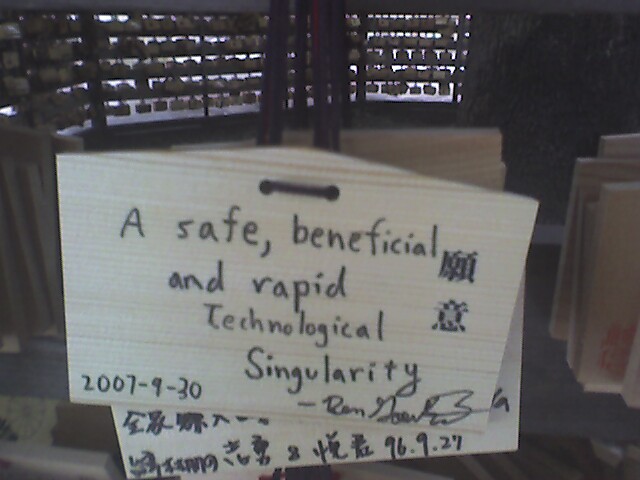
In September 2007 I went on a two week business/science trip to China (Wuhan and Beijing) and Japan (Tokyo). In between some very interesting and productive meetings, I had a bit of free time, and so among other things I wound up formally submitting a prayer to the Japanese gods for a rapid, beneficial technological Singularity. Let's hope they were listening!
I wrote this blog post on the flight home but wasn't in a silly enough mood to post it till now.
(Scroll to the bottom if you're in a hurry; after all the irrelevant rambling beforehand, there's a sort of punchline there, involving the mysterious inscription in the above picture.)
My trip started in Wuhan, where I gave two talks at an AI conference and visited with Hugo de Garis and his students (his apprentice "brain builders"). Their near-term goal is to use genetic algorithms running on field-programmable gate arrays to control a funky little robot.
China was probably the most fascinating place I've ever visited (and I've visited and lived a lot of places), though in this brief trip I hardly got to know it at all. Society there is Westernizing fast (I've never seen anywhere more capitalist than modern China), but, there are still incredibly deep and dramatic differences between the Chinese and Western ways of thinking and living. As soon as I stepped into the airport, I was struck by the collectivist nature of their culture ...

... so very different from my own upbringing in which individuality was always held out as one of the highest values (I remember a book my mother got me as a young child, entitled Dare to Be Different -- a sort of history of famous nonconformists). There are of course many Chinese nonconformists (there are so many Chinese, there are many Chinese everything!), but in so many ways their whole society and culture is based on placing the group above the individual. (Which leads, among other things, to their enthusiasm for importing individualist Western scientists like Hugo de Garis.... But this is a topic for another blog post, some other day ... let me get on with my little story....)
Wuhan was a fascinating slice of "old China", with folks sitting out on the streets cooking weird food in woks, strange old men looking like they lived in 500 BC, and everywhere people, people, people. Alas I forgot to take pictures during my walks through the streets there.
Beijing by comparison was not too interesting -- too much like a modern Western city, but with terrible, yellow, reeking air. But the Great Wall, a bit north of Beijing, was really an amazing place. Too bad you aren't allowed to hike its full distance.


While hiking along the Great Wall, I asked for a sign from the Chinese gods that a positive Singularity was truly near. As if in some kind of response, a sudden gust of wind came up at that point...

I thought maybe the local gods would look more favorably on me if I ate some of the local cuisine, so I filled up on donkey, whole bullfrog, sea cucumber, duck's blood and pig foot fur and so forth. Not so bad as it sounds, but I still preferred the kung pao chicken.




(As well as consuming various recondite foodstuff items, in Beijing I visited the offices of HiPiHi.com, a very exciting Chinese virtual-worlds company ... but that's another story for another time....)
Next, I moved on to Tokyo (after some inordinately unpleasant logistical experiences in Beijing Capital airport, which I'd rather not revisit even in memory). The company I was visiting there was based in Shibuya, a suitably colorful and hypermodern Tokyo neighborhood:


Based on years of looking over my sons' shoulders as they watch anime', I expected all the Japanese people to look like these statues near Shibuya station:


In fact, some of the people I saw weren't so far off:


But more of them looked like this:

The Japanese love robots and cyborgs, and many of them seem to exhibit this love via making their own human selves as robotic as possible -- which is fascinating but odd, from my aging-American-hippy perspective. (I badly want to go beyond the human forms of body and mind, but I suppose that once this becomes possible, the result won't be much like contemporary machines -- rather it'll be something more fluid and flexible and creative than rigid old humanity.)
Toward the end of my stay, I got fed up with the hypermodernity, and I visited an old-time shrine in a beautiful park...

where I happened upon an intriguing site where Japanese go to submit prayers to the gods.
Each prayer is written down on a little piece of wood (which you buy for five dollars), then placed on a special prayer rack with all the others. The gods then presumably sort through them all (maybe with secretarial help from demigods or some such -- I didn't ask for the details), and decide which ones are worth granting, based on whatever godly criteria they utilize.


At first, the very concept caused the sea cucumber, duck's blood and twice-cooked donkey I'd eaten a few days before, much of which was still lingering in my stomach enjoying itself, to surge up through my gastrointestinal tract in a kind of disturbingly pleasing psychedelic can-can dance....

My next reaction was curiosity regarding what everyone else had prayed for. Sure, I could sorta guess, but it would have been nice to know in detail. But as the prayers were nearly all in Japanese, I couldn't really tell what they were all about, though a few gave small clues:

In the end, not wanting to be left out, I plunked down some yen to buy a little piece of wood and submitted my own prayer to the Japanese gods, to be considered along with the multitude of other human wants and needs. Hopefully the Japanese gods were in a generous mood that day -- for all our sakes!

Sunday, January 06, 2008
Nincompoopic Neurons, Global Brains and the Potential Sociological Applications of Adaptive Stochastic Resonance
My immediately previous blog post, on the apparently in-large-part nincompoopic nature of the emerging global brain
http://www.goertzel.org/blog/2007/12/global-moron-awakens.html
attracted so many comments (largely on various mailing lists I posted the blog URL to), that I figured I'd post a brief response here, expanding on some of the ideas in the responses and connecting them with some ideas from dynamical systems theory.
Most of the feedback I got was in the general vein of a blog post I wrote a couple months earlier, entitled "On Becoming a Neuron":
http://www.goertzel.org/blog/2007/10/on-becoming-neuron.html
The theme of "Becoming a Neuron" was how dependent we are, these days, on the global communication network and the emerging human group mind.
The theme of "The Global Nincompoop Awakens" was how many of the communications between the "human neurons" comprising the global brain seem completely idiotic in nature.
Reading through the comments on the Global Nincompoop post, I was struck by the theme of Bart Kosko' book Noise
http://www.amazon.com/Noise-Bart-Kosko/dp/0670034959
(a somewhat erratic book, but containing some very interesting ideas). Among other topics he reviews the way the brain's self-organizing cognitive dynamics depend on the high level of noise present in the brain, introducing the general notion of "adaptive stochastic resonance", according to which
Noise can amplify a faint signal in some feedback nonlinear systems even though too much noise can swamp the signal. This implies that a system’s optimal noise level need not be zero
(Google or Wikipedia "adaptive stochastic resonance" for a load of technical papers on the topic, by Kosko and others).
An interesting illustration of this phenomenon is the following figure from Kosko's paper

This picture shows nicely how, in the context of the human perceptual system, adding noise can help make patterns more perceptible.
(What's happening in the picture is that he's adding noise to the pixels in the picture, then applying a threshold rule to decide which pixels are black enough to display. Without enough noise, not enough pixels meet the threshold; with too much noise, too many pixels randomly meet the threshold. But it's worth letting a bunch of pixels randomly meet the threshold, in order to cause ENOUGH pixels to meet the threshold. So to optimize perception by a threshold-based system, you want to have an amount of noise lying in a certain interval -- not too little nor too much.)
Now, Kosko verges on insinuating that this kind of exploitation of noise is somehow a NECESSARY property of intelligent systems, which I doubt. However, it seems plausible that he's right about its role in the human brain and human perception/cognition.
Semi-relatedly, I recall reading somewhere that motion-sensing neurons in the brain are, on average, off by around 80 degrees in their assessment of the direction of motion of a percept at a certain point in the visual field. But we can still assess the direction of motion of an object fairly accurately, because our brains perform averaging, and the noisy data gets washed out in the average.
In other words, brains contain a lot of noise, and they contain mechanisms for working around this fact (e.g. averaging) and creatively exploiting it (e.g. adaptive stochastic resonance).
Now, it's not too surprising if the emerging Global Brain of humanity is more like a brain than like a well-engineered computer program. In other words: most of what goes on in the global brain, like most of what goes on in the human brain, is likely to be noise ... and there are likely to be mechanisms for both working around the noise, and exploiting it.
This brings up the interesting question of what techniques may exist in sociological dynamics for exploiting noise.
How might adaptive stochastic resonance, for example, play a role in sociodynamics? Could it be that the random noise of nincompoopic social interactions serve to make significant sociodynamic patterns stand out more clearly to our minds, thus actually enhancing the ability of the Global Brain to recognize patterns in itself?
I wonder how one would make an experiment to demonstrate or refute this? It would of course be difficult due to the massive number of confounding factors in any social system, and the difficulty of defining things like pattern and noise in the social domain as precisely as is possible in a domain like image processing (where of course these terms are still susceptible to a variety of interpretations).
And surely this simple idea -- obtained by extrapolating Kosko's image-processing example to the sociological domain -- is not the only possible way that social systems could profitably exploit their intrinsic noisiness.
But still, it's an intriguing train of thought....
(P.S. The question of whether this kind of chaotic, noisy, self-organizing system is remotely the best way to carry out creative computation is a whole other question, of course. My own strong suspicion is that human brains are incredibly inefficient at using their computational power, compared to other sorts of intelligent systems that will exist in the future; and the Global Brain likely shares this inefficiency, for similar reasons. However, this inefficiency is partially compensated for in both cases by biological systems' (neurons' and humans') prodigious capability for replication....)
http://www.goertzel.org/blog/2007/12/global-moron-awakens.html
attracted so many comments (largely on various mailing lists I posted the blog URL to), that I figured I'd post a brief response here, expanding on some of the ideas in the responses and connecting them with some ideas from dynamical systems theory.
Most of the feedback I got was in the general vein of a blog post I wrote a couple months earlier, entitled "On Becoming a Neuron":
http://www.goertzel.org/blog/2007/10/on-becoming-neuron.html
The theme of "Becoming a Neuron" was how dependent we are, these days, on the global communication network and the emerging human group mind.
The theme of "The Global Nincompoop Awakens" was how many of the communications between the "human neurons" comprising the global brain seem completely idiotic in nature.
Reading through the comments on the Global Nincompoop post, I was struck by the theme of Bart Kosko' book Noise
http://www.amazon.com/Noise-Bart-Kosko/dp/0670034959
(a somewhat erratic book, but containing some very interesting ideas). Among other topics he reviews the way the brain's self-organizing cognitive dynamics depend on the high level of noise present in the brain, introducing the general notion of "adaptive stochastic resonance", according to which
Noise can amplify a faint signal in some feedback nonlinear systems even though too much noise can swamp the signal. This implies that a system’s optimal noise level need not be zero
(Google or Wikipedia "adaptive stochastic resonance" for a load of technical papers on the topic, by Kosko and others).
An interesting illustration of this phenomenon is the following figure from Kosko's paper
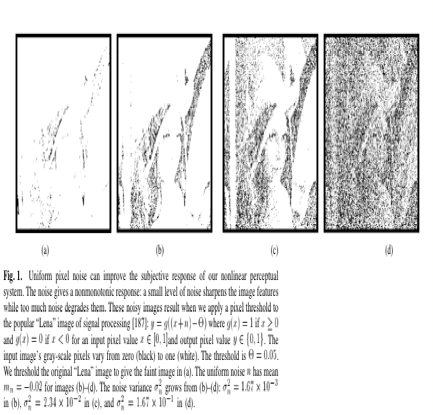
This picture shows nicely how, in the context of the human perceptual system, adding noise can help make patterns more perceptible.
(What's happening in the picture is that he's adding noise to the pixels in the picture, then applying a threshold rule to decide which pixels are black enough to display. Without enough noise, not enough pixels meet the threshold; with too much noise, too many pixels randomly meet the threshold. But it's worth letting a bunch of pixels randomly meet the threshold, in order to cause ENOUGH pixels to meet the threshold. So to optimize perception by a threshold-based system, you want to have an amount of noise lying in a certain interval -- not too little nor too much.)
Now, Kosko verges on insinuating that this kind of exploitation of noise is somehow a NECESSARY property of intelligent systems, which I doubt. However, it seems plausible that he's right about its role in the human brain and human perception/cognition.
Semi-relatedly, I recall reading somewhere that motion-sensing neurons in the brain are, on average, off by around 80 degrees in their assessment of the direction of motion of a percept at a certain point in the visual field. But we can still assess the direction of motion of an object fairly accurately, because our brains perform averaging, and the noisy data gets washed out in the average.
In other words, brains contain a lot of noise, and they contain mechanisms for working around this fact (e.g. averaging) and creatively exploiting it (e.g. adaptive stochastic resonance).
Now, it's not too surprising if the emerging Global Brain of humanity is more like a brain than like a well-engineered computer program. In other words: most of what goes on in the global brain, like most of what goes on in the human brain, is likely to be noise ... and there are likely to be mechanisms for both working around the noise, and exploiting it.
This brings up the interesting question of what techniques may exist in sociological dynamics for exploiting noise.
How might adaptive stochastic resonance, for example, play a role in sociodynamics? Could it be that the random noise of nincompoopic social interactions serve to make significant sociodynamic patterns stand out more clearly to our minds, thus actually enhancing the ability of the Global Brain to recognize patterns in itself?
I wonder how one would make an experiment to demonstrate or refute this? It would of course be difficult due to the massive number of confounding factors in any social system, and the difficulty of defining things like pattern and noise in the social domain as precisely as is possible in a domain like image processing (where of course these terms are still susceptible to a variety of interpretations).
And surely this simple idea -- obtained by extrapolating Kosko's image-processing example to the sociological domain -- is not the only possible way that social systems could profitably exploit their intrinsic noisiness.
But still, it's an intriguing train of thought....
(P.S. The question of whether this kind of chaotic, noisy, self-organizing system is remotely the best way to carry out creative computation is a whole other question, of course. My own strong suspicion is that human brains are incredibly inefficient at using their computational power, compared to other sorts of intelligent systems that will exist in the future; and the Global Brain likely shares this inefficiency, for similar reasons. However, this inefficiency is partially compensated for in both cases by biological systems' (neurons' and humans') prodigious capability for replication....)
Saturday, December 08, 2007
The Global Nincompoop Awakens
On a recent business trip to New York, I found myself sitting for a couple hours in a Starbucks in the midst of the campus of New York University (which is not a walled campus, but rather a collection of buildings strewn semi-haphazardly across a few blocks of Greenwich Village).
While sitting there typing into my laptop, I couldn't help being distracted by the conversations of the students around me. I attended NYU in the mid-80's (doing a bit of graduate study there on the way to my PhD), and I was curious to see how the zeitgest of the student body had changed.
Admittedly, this was a highly nonrepresentative sample, as I was observing only students who chose to hang out in Starbucks. (Most likely all the math and CS grad students were doing as I'd done during my time at NYU, and hanging out in the Courant Institute building, which was a lot quieter than any cafe' ...). And, the population of Starbucks seemed about 65% female, for whatever reason.
The first thing that struck me was the everpresence of technology. The students around me were constantly texting each other -- there was a lot of texting going on between people sitting in different parts of the Starbucks, or people waiting in line and other people sitting down, etc.
And, there was a lot of talk about Facebook. Pretty much anytime someone unfamiliar (to any of the conversation participants) was mentioned in conversation the question was asked "Are they on Facebook?" Of course, plenty of the students had laptops there and could write on each others Facebook walls while texting each other and slipping in the occasional voice phone call or email as well.
All in all I found the density and rapidity of information interchange extremely impressive. The whole social community of the Starbucks started to look like a multi-bodied meta-mind, with information zipping back and forth everywhere by various media. All the individuals comprising parts of the mind were obviously extremely well-attuned to the various component media and able to multiprocess very effectively, e.g. writing on someone's Facebook wall and then texting someone else while holding on an F2F conversation, all while holding a book in their lap and allegedly sort-of studying.
Exciting! The only problem was: The contents of what was being communicated was so amazingly trivial and petty it started to make me feel physically ill.
Pretty much all the electronic back-and-forth was about which guys were cute and might be interested in going to which party with which girls; or, how pathetic it was that a certain group of girls had "outgrown" a certain other group via being accepted into a certain sorority and developing a fuller and more mature appreciation for the compulsive consumption of alcohol ... and so forth.
Which led me to the following thought: Wow! With all our incredible communications technologies, we are creating a global brain! But 99.99% of this global brain's thoughts are going to be completely trite and idiotic.
Are we, perhaps, creating a global moron or at least a global nincompoop?
If taken seriously, this notion becomes a bit frightening.
Let's suppose that, at some point, the global communication network itself achieves some kind of spontaneous, self-organizing sentience.
(Yeah, this is a science-fictional hypothesis, and I don't think it's extremely likely to happen, but it's interesting to think about.)
Won't the contents of its mind somehow reflect the contents of the information being passed around the global communications network?
Say: porn, spam e-mails, endless chit-chat about whose buns are cuter, and so forth?
Won't the emergent global mind of the Internet thus inevitably be a shallow-minded, perverted and ridiculous dipshit?
Is this what we really want for the largest, most powerful mind on the planet?
What happens when this Global Moron asserts its powers over us? Will we all find our thoughts and behaviors subtly or forcibly directed by the Internet Overmind?? -- whose psyche is primarily directed by the contents of the Internet traffic from which it evolved ... which is primarily constituted of ... well... yecchh...
(OK .. fine ... this post is a joke... OR IS IT???)
While sitting there typing into my laptop, I couldn't help being distracted by the conversations of the students around me. I attended NYU in the mid-80's (doing a bit of graduate study there on the way to my PhD), and I was curious to see how the zeitgest of the student body had changed.
Admittedly, this was a highly nonrepresentative sample, as I was observing only students who chose to hang out in Starbucks. (Most likely all the math and CS grad students were doing as I'd done during my time at NYU, and hanging out in the Courant Institute building, which was a lot quieter than any cafe' ...). And, the population of Starbucks seemed about 65% female, for whatever reason.
The first thing that struck me was the everpresence of technology. The students around me were constantly texting each other -- there was a lot of texting going on between people sitting in different parts of the Starbucks, or people waiting in line and other people sitting down, etc.
And, there was a lot of talk about Facebook. Pretty much anytime someone unfamiliar (to any of the conversation participants) was mentioned in conversation the question was asked "Are they on Facebook?" Of course, plenty of the students had laptops there and could write on each others Facebook walls while texting each other and slipping in the occasional voice phone call or email as well.
All in all I found the density and rapidity of information interchange extremely impressive. The whole social community of the Starbucks started to look like a multi-bodied meta-mind, with information zipping back and forth everywhere by various media. All the individuals comprising parts of the mind were obviously extremely well-attuned to the various component media and able to multiprocess very effectively, e.g. writing on someone's Facebook wall and then texting someone else while holding on an F2F conversation, all while holding a book in their lap and allegedly sort-of studying.
Exciting! The only problem was: The contents of what was being communicated was so amazingly trivial and petty it started to make me feel physically ill.
Pretty much all the electronic back-and-forth was about which guys were cute and might be interested in going to which party with which girls; or, how pathetic it was that a certain group of girls had "outgrown" a certain other group via being accepted into a certain sorority and developing a fuller and more mature appreciation for the compulsive consumption of alcohol ... and so forth.
Which led me to the following thought: Wow! With all our incredible communications technologies, we are creating a global brain! But 99.99% of this global brain's thoughts are going to be completely trite and idiotic.
Are we, perhaps, creating a global moron or at least a global nincompoop?
If taken seriously, this notion becomes a bit frightening.
Let's suppose that, at some point, the global communication network itself achieves some kind of spontaneous, self-organizing sentience.
(Yeah, this is a science-fictional hypothesis, and I don't think it's extremely likely to happen, but it's interesting to think about.)
Won't the contents of its mind somehow reflect the contents of the information being passed around the global communications network?
Say: porn, spam e-mails, endless chit-chat about whose buns are cuter, and so forth?
Won't the emergent global mind of the Internet thus inevitably be a shallow-minded, perverted and ridiculous dipshit?
Is this what we really want for the largest, most powerful mind on the planet?
What happens when this Global Moron asserts its powers over us? Will we all find our thoughts and behaviors subtly or forcibly directed by the Internet Overmind?? -- whose psyche is primarily directed by the contents of the Internet traffic from which it evolved ... which is primarily constituted of ... well... yecchh...
(OK .. fine ... this post is a joke... OR IS IT???)
Monday, October 29, 2007
On Becoming a Neuron
I was amused and delighted to read the following rather transhumanistic article in the New York Times recently.
http://www.nytimes.com/2007/10/26/opinion/26brooks.html?_r=1&oref=slogin
The writer, who does not appear to be a futurist or transhumanist or Singularitarian or anything like that, is observing the extent to which he has lost his autonomy and outsourced a variety of his cognitive functions to various devices with which he interacts. And he feels he has become stronger rather than weaker because of this -- and not any less of an individual.
This ties in deeply with the theme of the Global Brain
http://pespmc1.vub.ac.be/SUPORGLI.html
which is a concept dear to my heart ... I wrote about it extensively in my 2001 book "Creating Internet Intelligence" and (together with Francis Heylighen) co-organized the 2001 Global Brain 0 workshop in Brussels.
I have had similar thoughts to the above New York Times article many times recently... I can feel myself subjectively becoming far more part of the Global Brain than I was even 5 years ago, let alone 10...
As a prosaic example: Via making extensive use of task lists as described in the "Getting Things Done" methodology
http://en.wikipedia.org/wiki/Getting_Things_Done
I've externalized much of my medium-term memory about my work-life.
And via using Google Calendar extensively I have externalized my long-term memory... I use the calendar not only to record events but also to record information about what I should think about in the future (e.g. "Dec. 10 -- you should have time to start thinking about systems theory in connection to developmental psychology again...")
And, so much of my scientific work these days consists of reading little snippets of things that my colleagues on the Novamente project (or other intellectual collaborators) wrote, and then responding to them.... It's not that common these days that I undertake a large project myself, because I can always think of someone to collaborate with, and then the project becomes in significant part a matter of online back-and-forth....
And the process of doing computer science research is so different now than it was a decade or two ago, due to the ready availability and easy findability of so many research ideas, algorithms, code snippets etc. produced by other people.
Does this mean that I'm no longer an individual? It's certainly different than if I were sitting on a mountain for 10 years with my eagle and my lion like Nietzsche's Zarathustra.
But yet I don't feel like I've lost my distinctiveness and become somehow homogenized --
the way I interface with the synergetic network of machines and people is unique in complexly patterned ways, and constitutes my individuality.
Just as a neuron in the brain does not particularly manifest its individuality any less than a neuron floating by itself in a solution. In fact, the neuron in the brain may manifest its
individuality more greatly, due to having a richer, more complex variety of stimuli to which it may respond individually.
None of these observations are at all surprising from a Global Brain theory perspective. But, they're significant as real-time, subjectively-perceived and objectively-observed inklings of the accelerating emergence of a more and more powerful and coordinated Global Brain, of which we are parts.
And I think this ties in with Ray Kurzweil's point that by the time we have human-level AGI, it may not be "us versus them", it may be a case where it's impossible to draw the line between us and them...
-- Ben
P.S.
As a post-script, I think it's interesting to tie this Global Brain meme in with the possibility of a "controlled ascent" approach to the Singularity and the advent of the transhuman condition.
Looking forward to the stage at which we've created human-leve AGI's -- if these AGI's become smarter and smarter at an intentionally-controlled rate (say a factor of 1.2 per year, just to throw a number out there), and if humans are intimately interlinked with these AGI's in a Global Brain like fashion (as does seem to be occurring, at an accelerating rate), then we have a quite interesting scenario.
Of course I realize that guaranteeing this sort of controlled ascent is a hard problem. And I realize there are ethical issues involved in making sure a controlled ascent like this respects the rights of individuals who choose not to ascend at all. And I realize that those who want to ascend faster may get irritated at the slow pace. All these points need addressing in great detail by an informed and intelligent and relevantly educated community, but they aren't my point right now -- my point in this postcript is the synergetic interrelation of the Global Brain meme with the controlled-ascent meme.
The synergy here is that as the global brain gets smarter and smarter, and we get more and more richly integrated into it, and the AGI's that will increasingly drive the development of the global brain get smarter and smarter -- there is a possibility that we will become more and more richly integrated with a greater whole, while at the same time having greater capability to exercise our uniqueness and individually.
O Brave New Meta-mind, etc. etc. ;-)
http://www.nytimes.com/2007/10/26/opinion/26brooks.html?_r=1&oref=slogin
The writer, who does not appear to be a futurist or transhumanist or Singularitarian or anything like that, is observing the extent to which he has lost his autonomy and outsourced a variety of his cognitive functions to various devices with which he interacts. And he feels he has become stronger rather than weaker because of this -- and not any less of an individual.
This ties in deeply with the theme of the Global Brain
http://pespmc1.vub.ac.be/SUPORGLI.html
which is a concept dear to my heart ... I wrote about it extensively in my 2001 book "Creating Internet Intelligence" and (together with Francis Heylighen) co-organized the 2001 Global Brain 0 workshop in Brussels.
I have had similar thoughts to the above New York Times article many times recently... I can feel myself subjectively becoming far more part of the Global Brain than I was even 5 years ago, let alone 10...
As a prosaic example: Via making extensive use of task lists as described in the "Getting Things Done" methodology
http://en.wikipedia.org/wiki/Getting_Things_Done
I've externalized much of my medium-term memory about my work-life.
And via using Google Calendar extensively I have externalized my long-term memory... I use the calendar not only to record events but also to record information about what I should think about in the future (e.g. "Dec. 10 -- you should have time to start thinking about systems theory in connection to developmental psychology again...")
And, so much of my scientific work these days consists of reading little snippets of things that my colleagues on the Novamente project (or other intellectual collaborators) wrote, and then responding to them.... It's not that common these days that I undertake a large project myself, because I can always think of someone to collaborate with, and then the project becomes in significant part a matter of online back-and-forth....
And the process of doing computer science research is so different now than it was a decade or two ago, due to the ready availability and easy findability of so many research ideas, algorithms, code snippets etc. produced by other people.
Does this mean that I'm no longer an individual? It's certainly different than if I were sitting on a mountain for 10 years with my eagle and my lion like Nietzsche's Zarathustra.
But yet I don't feel like I've lost my distinctiveness and become somehow homogenized --
the way I interface with the synergetic network of machines and people is unique in complexly patterned ways, and constitutes my individuality.
Just as a neuron in the brain does not particularly manifest its individuality any less than a neuron floating by itself in a solution. In fact, the neuron in the brain may manifest its
individuality more greatly, due to having a richer, more complex variety of stimuli to which it may respond individually.
None of these observations are at all surprising from a Global Brain theory perspective. But, they're significant as real-time, subjectively-perceived and objectively-observed inklings of the accelerating emergence of a more and more powerful and coordinated Global Brain, of which we are parts.
And I think this ties in with Ray Kurzweil's point that by the time we have human-level AGI, it may not be "us versus them", it may be a case where it's impossible to draw the line between us and them...
-- Ben
P.S.
As a post-script, I think it's interesting to tie this Global Brain meme in with the possibility of a "controlled ascent" approach to the Singularity and the advent of the transhuman condition.
Looking forward to the stage at which we've created human-leve AGI's -- if these AGI's become smarter and smarter at an intentionally-controlled rate (say a factor of 1.2 per year, just to throw a number out there), and if humans are intimately interlinked with these AGI's in a Global Brain like fashion (as does seem to be occurring, at an accelerating rate), then we have a quite interesting scenario.
Of course I realize that guaranteeing this sort of controlled ascent is a hard problem. And I realize there are ethical issues involved in making sure a controlled ascent like this respects the rights of individuals who choose not to ascend at all. And I realize that those who want to ascend faster may get irritated at the slow pace. All these points need addressing in great detail by an informed and intelligent and relevantly educated community, but they aren't my point right now -- my point in this postcript is the synergetic interrelation of the Global Brain meme with the controlled-ascent meme.
The synergy here is that as the global brain gets smarter and smarter, and we get more and more richly integrated into it, and the AGI's that will increasingly drive the development of the global brain get smarter and smarter -- there is a possibility that we will become more and more richly integrated with a greater whole, while at the same time having greater capability to exercise our uniqueness and individually.
O Brave New Meta-mind, etc. etc. ;-)
Friday, June 15, 2007
The Pigeons of Paraguay (Further Dreams of a Ridiculous Man)
In the spirit of my prior dream-description Colors, I have written down another dream ... one I had last night ... it's in the PDF file linked to from
Copy Girl and the Pigeons of Paraguay
I'm not sure why I felt inspired to, but as soon as I woke up from the dream I had the urge to type it in (along with some prefatory and interspersed rambling!) It really wasn't a terribly important dream for me ... but it was interesting as an example of a dream containing a highly realistic psychedelic drug trip inside it. There is also a clear reference to the "Colors" dream within this one, which is not surprising -- my dreams all tend to link into each other, as if they form their own connected universe, separate from and parallel to this one.
I have always enjoyed writing "dreamlike" fiction, such as my freaky semi-anti-novel Echoes of the Great Farewell ... but lately I've become interested in going straight to the source, and naturalistically recording dreams themselves ... real dreams being distinctly and clearly different from dreamlike fiction. Real dreams have more ordinariness about them, more embarrassing boringness and cliche'-ness; and also more herky-jerky discoordination.... They are not as aesthetic, which of course gives them their own special aesthetic value (on a meta-aesthetic level, blah blah blah...). Their plain-ness and lack of pretension gives them, in some ways, a deeper feel of truth than their more poetized fictional cousins....
The dream I present here has no particular scientific or philosophical value, it's just a dream that amused me. It reminded me toward the end a bit of Dostoevsky's Dream of a Ridiculous Man -- not in any details, but because of (how to put it???) the weird combination of irony and sincerity with which the psychic theme of sympathy and the oneness of humankind is addressed. Yeah yeah yeah. Paraguayan pigeons!! A billion blue blistering barnacles in a thundering typhoon!!!
I'll give you some mathematics in my next blog entry ;-)
-- Ben
Copy Girl and the Pigeons of Paraguay
I'm not sure why I felt inspired to, but as soon as I woke up from the dream I had the urge to type it in (along with some prefatory and interspersed rambling!) It really wasn't a terribly important dream for me ... but it was interesting as an example of a dream containing a highly realistic psychedelic drug trip inside it. There is also a clear reference to the "Colors" dream within this one, which is not surprising -- my dreams all tend to link into each other, as if they form their own connected universe, separate from and parallel to this one.
I have always enjoyed writing "dreamlike" fiction, such as my freaky semi-anti-novel Echoes of the Great Farewell ... but lately I've become interested in going straight to the source, and naturalistically recording dreams themselves ... real dreams being distinctly and clearly different from dreamlike fiction. Real dreams have more ordinariness about them, more embarrassing boringness and cliche'-ness; and also more herky-jerky discoordination.... They are not as aesthetic, which of course gives them their own special aesthetic value (on a meta-aesthetic level, blah blah blah...). Their plain-ness and lack of pretension gives them, in some ways, a deeper feel of truth than their more poetized fictional cousins....
The dream I present here has no particular scientific or philosophical value, it's just a dream that amused me. It reminded me toward the end a bit of Dostoevsky's Dream of a Ridiculous Man -- not in any details, but because of (how to put it???) the weird combination of irony and sincerity with which the psychic theme of sympathy and the oneness of humankind is addressed. Yeah yeah yeah. Paraguayan pigeons!! A billion blue blistering barnacles in a thundering typhoon!!!
I'll give you some mathematics in my next blog entry ;-)
-- Ben
Saturday, June 02, 2007
Is Google Secretly Creating an AGI? (Reasons Why I Doubt It)
From time to time someone suggests to me that Google "must be" developing a powerful Artificial General Intelligence in-house. I recently had the opportunity to visit Google and chat with some of their research staff, including Peter Norvig, their Director of Research. So I thought I'd share my perspective on Google+AGI based on the knowledge currently at my disposal.
First let me say that I definitely see where the Google+AGI speculation comes from. It's not just that they've hired a bunch of AI PhD's and have a lot of money and computers. It's that their business leaders have taken to waxing eloquent about the glorious future of artificial intelligence. For instance, on the blog
http://memepunks.blogspot.com/2006/05/google-ai-twinkle-in-larry-pages-eye.html
we find some quotes from Google co-founder Larry Page:
"People always make the assumption that we're done with search. That's very far from the case. We're probably only 5 percent of the way there. We want to create the ultimate search engine that can understand anything ... some people could call that artificial intelligence.
...
a lot of our systems already use learning techniques
...
The ultimate search engine would understand everything in the world. It would understand everything that you asked it and give you back the exact right thing instantly ... You could ask 'what should I ask Larry?' and it would tell you."
Page, in the same talk quoted there, noted that technology has a tendency to change faster than expected, and that an AI could be a reality in just a few years.
Exciting rhetoric indeed!
Anyway, earlier this week I gave a talk at Google, to a group of in-house researchers and engineers, on the topic of artificial general intelligence. I was rather overtired and sick when I gave the talk, so it wasn't anywhere near one of my best talks on AGI and Novamente. Blecch. Parts of it were well delivered; but I didn't pace myself as well as usual, so I wound up rushing past some of the interesting points and not giving my usual stirring conclusion.... But some of the younger staff were pretty interested anyway; and there were some fun follow-up conversations.
Peter Norvig (their Director of Research), an all-around great researcher and writer and great guy, gave the intro to my talk. I had chatted with Peter a bit earlier; and had mentioned to him that some folks I knew in the AGI community suspected Google to have a top-secret AGI project.
So anyway, Peter gave the following intro to my talk [I am paraphrasing here, not quoting exactly ... but I've tried to stay true to what he said, as accurately as possible given the constraints of my all-too-human memory]:
"There has been some talk about whether Google has a top-secret project aimed at building a thinking machine. Well, I'll tell you what happened. Larry Page came to me and said 'Peter, I've been hearing a lot about this Strong AI stuff. Shouldn't we be doing something in that direction?' So I said, okay. I went back to my desk and logged into our project management software. I had to write some scripts to modify it because it didn't go far enough into the future. But I modified it so that I could put, 'Human-level intelligence' on the row of the planning spreadsheet corresponding to the year 2030. And, that wasn't up there an hour before someone else added another item to the spreadsheet, time-stamped 90 days after that: 'Human-level intelligence: Macintosh port' "
Well ... soooo ... apparently Norvig, at least in a semi-serious tongue-in-cheek moment, thinks we're about 23 years from being able to create a thinking machine....
He may be right of course -- or he may even be over-optimistic, who knows -- but a cynical side of me can't help thinking: "Hey, Ben! Peter Norvig is even older than you are! Maybe placing the end goal 23 years off is just a way of saying 'Somebody else's problem!'."
Norvig says he views himself as building useful tools that will accelerate the work of future AGI researchers, along with everyone else....
Of course, I do appreciate Google's useful tools! Google's various tools have been quite a relief as compared to the incompetently-architected, user-unfriendly software released by some other major software firms.
And, while from a societal perspective I wish Google would put their $$ and hardware behind AGI; from the perspective of my small AGI business Novamente LLC, their current attitude is surely preferable...
[I could discourse a while about Google's ethics slogan "Don't Be Evil" as a philosophy of Friendly AI ... but I'll resist the urge...]
When I shared the above story with one of my AGI researcher friends (who shall here remain anonymous), he agreed with my sentiments, and shared the following story with me..
"In [month deleted] I had an interview in Google's new [location deleted] office
... and they were much more interested in my programming skill than in my research. Of course, we didn't find a match.
Even if Google wants to do AGI, given their current technical culture,
they won't get it right, at least at the beginning. As far as AGI is
concerned, Google has more than enough money and engineers, but less
than enough thinkers. They will produce some cute toolbox with smart
algorithms supported by a huge amount of raw data, which will be
interesting, but far from AGI."
Summing up ... as the above anecdotes suggest, my overall impression was that Google is not making any serious effort at AGI. If they are, then either
Of course, neither of these is an impossibility -- "we don't know what we don't know," etc. But honestly, I rate both of those options as pretty unlikely.
Could they launch an AGI effort? Most surely: they could, at any point. The cost to them of doing so would be trivially small, relative to the overall resources at their disposal. Maybe this blog post will egg them into doing so! (yeah, right...)
But I think the point my above-quoted friend made, after his Google interview, was quite astute. Google's technical culture is coding-focused, and their approach to AI is data-focused (textual data, and data regarding clicks on ads, and geospatial data coming into Google Earth, etc.). To get hired at Google you have to be a great coder -- just being a great AGI theorist wouldn't be enough, for example. I don't think AGI is mainly a coding problem, nor mainly a data-based problem ... nor do I think it's a problem that can effectively be solved via a "great coding + lots of data" mentality. I think AGI is a deep conceptual problem that has more to do wth understanding cognition than with churning out great code and effectively utilizing masses of data. Of course, lots of great software engineering will be required to create an AGI (and we're happy to have a few super-engineers within Novamente LLC, for example), and lots of data too (e.g. in the Novamente case we plan to start our systems out with perceptual and social data from virtual worlds like Second Life; and then later on feed them knowledge from Wikipedia and other textual sources). But if the focus of an "AGI" team is on coding and data, rather than on grokking the essence of cognition, AGI is not going to be the result.
So, IMO, for Google to create an AGI would require them not only to bypass the relative AGI skepticism represented by the Peter Norvig story above -- but also to operate an AGI project based on a significantly different culture than the one that has worked for Google so far, in their development of (in some cases, really outstandingly useful) narrow-AI applications.
All in all my impression after getting to know Google's in-house research program a little better, is about the same as it was beforehand. However, I did make an explicit effort to look for evidence disconfirming my prior hypotheses -- and I didn't really find any. If anyone has evidence that the impressions I've given here are mistaken, I'd certainly be happy to hear it.
OK, well, it's time to wind up this blog post and get back to my own effort to create AGI -- with far less money and computers than Google, but -- at least -- a focus on (and, I believe, a clear understanding of) the essence of the problem....
Sure, it would be nice to have the resources of a Google or M$ or IBM backing up Novamente! But, the thing is, you don't become a big company like those by focusing on grokking the essence of cognition -- you become a big company like those by focusing on practical stuff that makes money quickly, like code and data and user interfaces ... and if AI plays a role in this, it's problem-specific narrow-AI, such as Google has done so well with.
As Larry Page recognizes, AGI will certainly have massive business value, due to its incredible potential for delivering useful services to people in a huge number of contexts. But the culture and mentality needed to create AGI seems to be different from the one needed to rapidly create a large and massively profitable company. My prediction is that if Google ever does get an AGI, they will buy it rather than build it.
First let me say that I definitely see where the Google+AGI speculation comes from. It's not just that they've hired a bunch of AI PhD's and have a lot of money and computers. It's that their business leaders have taken to waxing eloquent about the glorious future of artificial intelligence. For instance, on the blog
http://memepunks.blogspot.com/2006/05/google-ai-twinkle-in-larry-pages-eye.html
we find some quotes from Google co-founder Larry Page:
"People always make the assumption that we're done with search. That's very far from the case. We're probably only 5 percent of the way there. We want to create the ultimate search engine that can understand anything ... some people could call that artificial intelligence.
...
a lot of our systems already use learning techniques
...
The ultimate search engine would understand everything in the world. It would understand everything that you asked it and give you back the exact right thing instantly ... You could ask 'what should I ask Larry?' and it would tell you."
Page, in the same talk quoted there, noted that technology has a tendency to change faster than expected, and that an AI could be a reality in just a few years.
Exciting rhetoric indeed!
Anyway, earlier this week I gave a talk at Google, to a group of in-house researchers and engineers, on the topic of artificial general intelligence. I was rather overtired and sick when I gave the talk, so it wasn't anywhere near one of my best talks on AGI and Novamente. Blecch. Parts of it were well delivered; but I didn't pace myself as well as usual, so I wound up rushing past some of the interesting points and not giving my usual stirring conclusion.... But some of the younger staff were pretty interested anyway; and there were some fun follow-up conversations.
Peter Norvig (their Director of Research), an all-around great researcher and writer and great guy, gave the intro to my talk. I had chatted with Peter a bit earlier; and had mentioned to him that some folks I knew in the AGI community suspected Google to have a top-secret AGI project.
So anyway, Peter gave the following intro to my talk [I am paraphrasing here, not quoting exactly ... but I've tried to stay true to what he said, as accurately as possible given the constraints of my all-too-human memory]:
"There has been some talk about whether Google has a top-secret project aimed at building a thinking machine. Well, I'll tell you what happened. Larry Page came to me and said 'Peter, I've been hearing a lot about this Strong AI stuff. Shouldn't we be doing something in that direction?' So I said, okay. I went back to my desk and logged into our project management software. I had to write some scripts to modify it because it didn't go far enough into the future. But I modified it so that I could put, 'Human-level intelligence' on the row of the planning spreadsheet corresponding to the year 2030. And, that wasn't up there an hour before someone else added another item to the spreadsheet, time-stamped 90 days after that: 'Human-level intelligence: Macintosh port' "
Well ... soooo ... apparently Norvig, at least in a semi-serious tongue-in-cheek moment, thinks we're about 23 years from being able to create a thinking machine....
He may be right of course -- or he may even be over-optimistic, who knows -- but a cynical side of me can't help thinking: "Hey, Ben! Peter Norvig is even older than you are! Maybe placing the end goal 23 years off is just a way of saying 'Somebody else's problem!'."
Norvig says he views himself as building useful tools that will accelerate the work of future AGI researchers, along with everyone else....
Of course, I do appreciate Google's useful tools! Google's various tools have been quite a relief as compared to the incompetently-architected, user-unfriendly software released by some other major software firms.
And, while from a societal perspective I wish Google would put their $$ and hardware behind AGI; from the perspective of my small AGI business Novamente LLC, their current attitude is surely preferable...
[I could discourse a while about Google's ethics slogan "Don't Be Evil" as a philosophy of Friendly AI ... but I'll resist the urge...]
When I shared the above story with one of my AGI researcher friends (who shall here remain anonymous), he agreed with my sentiments, and shared the following story with me..
"In [month deleted] I had an interview in Google's new [location deleted] office
... and they were much more interested in my programming skill than in my research. Of course, we didn't find a match.
Even if Google wants to do AGI, given their current technical culture,
they won't get it right, at least at the beginning. As far as AGI is
concerned, Google has more than enough money and engineers, but less
than enough thinkers. They will produce some cute toolbox with smart
algorithms supported by a huge amount of raw data, which will be
interesting, but far from AGI."
Summing up ... as the above anecdotes suggest, my overall impression was that Google is not making any serious effort at AGI. If they are, then either
- they have trained dozens of their scientific staff to be really good actors, or
- it is a super-top-secret effort within Google Irkutsk or wherever, that the Google Mountain View research staff don't know about
Of course, neither of these is an impossibility -- "we don't know what we don't know," etc. But honestly, I rate both of those options as pretty unlikely.
Could they launch an AGI effort? Most surely: they could, at any point. The cost to them of doing so would be trivially small, relative to the overall resources at their disposal. Maybe this blog post will egg them into doing so! (yeah, right...)
But I think the point my above-quoted friend made, after his Google interview, was quite astute. Google's technical culture is coding-focused, and their approach to AI is data-focused (textual data, and data regarding clicks on ads, and geospatial data coming into Google Earth, etc.). To get hired at Google you have to be a great coder -- just being a great AGI theorist wouldn't be enough, for example. I don't think AGI is mainly a coding problem, nor mainly a data-based problem ... nor do I think it's a problem that can effectively be solved via a "great coding + lots of data" mentality. I think AGI is a deep conceptual problem that has more to do wth understanding cognition than with churning out great code and effectively utilizing masses of data. Of course, lots of great software engineering will be required to create an AGI (and we're happy to have a few super-engineers within Novamente LLC, for example), and lots of data too (e.g. in the Novamente case we plan to start our systems out with perceptual and social data from virtual worlds like Second Life; and then later on feed them knowledge from Wikipedia and other textual sources). But if the focus of an "AGI" team is on coding and data, rather than on grokking the essence of cognition, AGI is not going to be the result.
So, IMO, for Google to create an AGI would require them not only to bypass the relative AGI skepticism represented by the Peter Norvig story above -- but also to operate an AGI project based on a significantly different culture than the one that has worked for Google so far, in their development of (in some cases, really outstandingly useful) narrow-AI applications.
All in all my impression after getting to know Google's in-house research program a little better, is about the same as it was beforehand. However, I did make an explicit effort to look for evidence disconfirming my prior hypotheses -- and I didn't really find any. If anyone has evidence that the impressions I've given here are mistaken, I'd certainly be happy to hear it.
OK, well, it's time to wind up this blog post and get back to my own effort to create AGI -- with far less money and computers than Google, but -- at least -- a focus on (and, I believe, a clear understanding of) the essence of the problem....
Sure, it would be nice to have the resources of a Google or M$ or IBM backing up Novamente! But, the thing is, you don't become a big company like those by focusing on grokking the essence of cognition -- you become a big company like those by focusing on practical stuff that makes money quickly, like code and data and user interfaces ... and if AI plays a role in this, it's problem-specific narrow-AI, such as Google has done so well with.
As Larry Page recognizes, AGI will certainly have massive business value, due to its incredible potential for delivering useful services to people in a huge number of contexts. But the culture and mentality needed to create AGI seems to be different from the one needed to rapidly create a large and massively profitable company. My prediction is that if Google ever does get an AGI, they will buy it rather than build it.
Friday, May 25, 2007
Pure Silliness
Ode to the Perplexingness of the Multiverse
A clever chap, just twenty-nine
Found out how to go backwards in time
He went forty years back
Killed his mom with a whack
Then said "How can it be that still I'm?"
On the Dangers of Incautious Research and Development
A scientist, slightly insane
Created a robotic brain
But the brain, on completion
Favored assimilation
His final words: "Damn, what a pain!"
A couple clever followups to the above poem were posted by others on the Singularity email list...
On the Dangers of Emulating Biological Drives in Artificial Intelligences
(by Moshe Looks)
A scientist once shook his head
and exclaimed "My career is now dead;
for although my AI
has an IQ that's high
it insists it exists to be bred!"
By Derek Zahn:
The Provably Friendly AI
Was such a considerate guy!
Upon introspection
And careful reflection,
It shut itself off with a sigh.
And, less interestingly...
On the Benefits of Clarity in Verbal Presentation
There was a prize pig from Penn Station
Who refused to eschew obfuscation
The swine with whom he traveled
Were bedazed by his babble
So they baconed him, out of frustration
Sunday, May 20, 2007
Flogging Poor Searle Again
Someone emailed me recently about Searle's Chinese Room argument,
http://en.wikipedia.org/wiki/Chinese_room
a workhorse theme in the philosophy of AI that normally bores me to tears.
But though the Chinese room bores me, part of my reply to the guy's question wound up interesting me slightly so I thought I'd repeat it here.
I won't recapitulate the Chinese room argument here; if you don't know it please follow the above link to Wikipedia.
The issue I'll raise here ties in with the question of whether recent theoretical developments regarding "AI with massive amounts of processing power" have any relevance to pragmatic AI.
As an example of this sort of theoretical research, check out:
http://www.hutter1.net/
which describes among other things an AI system called AIXI that uses infinitely much computational resources and achieves a level of intelligence greater than or equal to that of any other possible AI system. There are also approximations to AIXI such as AIXItl that use only insanely rather than infinitely much computational resources.
My feeling is that one should think about, not just
Intelligence = complexity of goals that a system can achieve
but also
Efficient intelligence = Sum over goals a system can achieve of: (complexity of the goal)/(amount of space and time resources required to achieve the goal)
According to these definitions, AIXI has zero efficient intelligence, and AIXItl has extremely low efficient intelligence. The challenge of AI in the real world is in achieving efficient intelligence not just raw intelligence.
Also, according to these definitions, the Bekenstein bound places a limit on the maximal efficient intelligence of any system in the physical universe.
Now, back to the Chinese room (hmm, writing this blog post is making me hungry ... after I'm done typing it I'm going to head out for some Kung Pao chicken!!)....
A key point is: The scenario Searle describes is likely not physically possible, due to the unrealistically large size of the rulebook.
And even if Searle's scenario somehow comes out physically plausible (e.g. maybe Bekenstein is wrong due to currently unknown physics), it certainly involves systems totally unlike any that we have ever encountered. Our terms like "intelligence" and "understanding" and "mind" were not created for dealing with massive-computational-resources systems of this nature.
The structures that we associate with intelligence (will, focused awareness, etc.) in a human context, all come out of the need to do intelligent processing within modest space and time requirements.
So when someone says the feel like the {Searle+rulebook} system isn't really understanding Chinese, what they really mean (I argue) is: It isn't understanding Chinese according to the methods we are used to, which are methods adapted to deal with modest space and time resources.
This ties in with the relationship between intensity-of-consciousness and degree-of-intelligence.
(Note that I write about intensity of consciousness rather than presence of consciousness. I tend toward panpsychism but I do accept that "while all animals are conscious, some animals are more conscious than others" (to pervert Orwell). I have elaborated on this perspective considerably in my 2006 book The Hidden Pattern.)
In real life, these seem often to be tied together, because the cognitive structures that correlate with intensity of consciousness are useful ones for achieving intelligent behaviors.
However, Searle's scenario is pathological in the sense that it posits a system with a high degree of intelligence associated with a functionality (understanding Chinese) that is NOT associated with any intensity-of-consciousness.
But I suggest that this pathology is due to the unrealistically large amount of computing resources that the rulebook requires.
I.e., it is finitude of resources that causes intelligence and intensity-of-consciousness to be correlated. The fact that this correlation breaks in a pathological, physically-impossible case that requires dramatically much resources, doesn't mean too much...
What it means is that "understanding", as we understand it, has to do with structures and dynamics of mind that arise due to having to manifest efficient intelligence, not just intelligence.
That is really the moral of the Chinese room.
http://en.wikipedia.org/wiki
a workhorse theme in the philosophy of AI that normally bores me to tears.
But though the Chinese room bores me, part of my reply to the guy's question wound up interesting me slightly so I thought I'd repeat it here.
I won't recapitulate the Chinese room argument here; if you don't know it please follow the above link to Wikipedia.
The issue I'll raise here ties in with the question of whether recent theoretical developments regarding "AI with massive amounts of processing power" have any relevance to pragmatic AI.
As an example of this sort of theoretical research, check out:
http://www.hutter1.net/
which describes among other things an AI system called AIXI that uses infinitely much computational resources and achieves a level of intelligence greater than or equal to that of any other possible AI system. There are also approximations to AIXI such as AIXItl that use only insanely rather than infinitely much computational resources.
My feeling is that one should think about, not just
Intelligence = complexity of goals that a system can achieve
but also
Efficient intelligence = Sum over goals a system can achieve of: (complexity of the goal)/(amount of space and time resources required to achieve the goal)
According to these definitions, AIXI has zero efficient intelligence, and AIXItl has extremely low efficient intelligence. The challenge of AI in the real world is in achieving efficient intelligence not just raw intelligence.
Also, according to these definitions, the Bekenstein bound places a limit on the maximal efficient intelligence of any system in the physical universe.
Now, back to the Chinese room (hmm, writing this blog post is making me hungry ... after I'm done typing it I'm going to head out for some Kung Pao chicken!!)....
A key point is: The scenario Searle describes is likely not physically possible, due to the unrealistically large size of the rulebook.
And even if Searle's scenario somehow comes out physically plausible (e.g. maybe Bekenstein is wrong due to currently unknown physics), it certainly involves systems totally unlike any that we have ever encountered. Our terms like "intelligence" and "understanding" and "mind" were not created for dealing with massive-computational-resources systems of this nature.
The structures that we associate with intelligence (will, focused awareness, etc.) in a human context, all come out of the need to do intelligent processing within modest space and time requirements.
So when someone says the feel like the {Searle+rulebook} system isn't really understanding Chinese, what they really mean (I argue) is: It isn't understanding Chinese according to the methods we are used to, which are methods adapted to deal with modest space and time resources.
This ties in with the relationship between intensity-of-consciousness and degree-of-intelligence.
(Note that I write about intensity of consciousness rather than presence of consciousness. I tend toward panpsychism but I do accept that "while all animals are conscious, some animals are more conscious than others" (to pervert Orwell). I have elaborated on this perspective considerably in my 2006 book The Hidden Pattern.)
In real life, these seem often to be tied together, because the cognitive structures that correlate with intensity of consciousness are useful ones for achieving intelligent behaviors.
However, Searle's scenario is pathological in the sense that it posits a system with a high degree of intelligence associated with a functionality (understanding Chinese) that is NOT associated with any intensity-of-consciousness.
But I suggest that this pathology is due to the unrealistically large amount of computing resources that the rulebook requires.
I.e., it is finitude of resources that causes intelligence and intensity-of-consciousness to be correlated. The fact that this correlation breaks in a pathological, physically-impossible case that requires dramatically much resources, doesn't mean too much...
What it means is that "understanding", as we understand it, has to do with structures and dynamics of mind that arise due to having to manifest efficient intelligence, not just intelligence.
That is really the moral of the Chinese room.

Tuesday, May 15, 2007
Technological versus Subjective Acceleration
This post is motivated by an ongoing argument with Phil Goetz, a local friend who believes that all this talk about "accelerating change" and approaching the Singularity is bullshit -- in part because he doesn't see things advancing all that amazingly exponentially rapidly around him.
There is plenty of room for debate about the statistics of accelerating change: clearly some things are advancing way faster than others. Computer chips and brain scanners are advancing more rapidly than forks or refrigerators. In this regard, I think, the key question is whether Singularity-enabling technologies are advancing exponentially (and I think enough of them are to make a critical difference). But that's not the point I want to get at here.
The point I want to make here is: I think it is important to distinguish technological accel eration from subjective acceleration.
This breaks down into a couple sub-points.
First: Already by this point in history, I suggest, advancement in technology has far outpaced the ability of the human brain to figure out new ways to make meaningful use of that technology.
Second: The human brain and body themselves pose limitations regarding how thoroughly we can make use of new technologies, in terms of transforming our subjective experience.
Because of these two points, a very high rate of technological acceleration may not lead to a comparably high rate of subjective acceleration. Which is, I think, the situation we are seeing at present.
Regarding the first point: Note that long ago in history, when new technology was created, it lasted quite a while before being obsoleted, so that each new technology was exploited pretty damn thoroughly before its successor came along.
These days, though, we've just BARELY begun figuring out how to creatively exploit X, when something way better than X comes along.
The example of music may serve to illustrate both of these points.
The invention of the electronic synthesizer/sampler keyboard was a hell of a breakthrough. However, the music we humans actually make has not changed nearly as much as the underlying technology has. By and large we use all this advanced technology to make stuff that sounds harmonically, rhythmically and melodically not that profoundly different from pre-synthesizer music. Certainly, the degree of musical change has not kept up with the degree of technological change: Madonna is not as different from James Brown as a synthesizer keyboard is from an electric guitar.
Why is that?
Well, humans take a while to adapt. People are still learning how to make optimal use of synthesizer/sampling keyboards for making intersting music ... but while people are still relatively early on that learning curve, technology has advanced yet further and computer music software gives us amazing new possibilities ... that we've barely begun to exploit...
Furthermore, our musical tastes are limited by our physiology. I could make fabulously complex music using a sequencer, with 1000's of intersecting melody lines carefully calculated, but no human would be able to understand it (I tried ;-). Maybe superhuman minds will be able to use modern music tech to create music far subtler and more interesting than any human music, for their own consumption.
And, even when acoustic and cognitive physiology isn't relevant, the rate of growth and change in a person's music appreciation is limited by their personality psychology.
To take another example, let's look at bioinformatics. No doubt that technology for measuring biological systems has advanced exponentially. As has technology for analyzing biological data using AI (my part of that story).
But, AI-based methods are very slow to pervade the biology community due to cultural and educational issues ... most biologist can barely deal with stats, let alone AI tech....
And, the most advanced measurement machinery is often not used in the most interesting possible ways. For instance, microarray devices allow biologists to take a whole-genome approach to studying biological systems, but, most biologists use them in a very limited manner, guided by an "archaic" single-gene-focused mentality. So much of the power of the technology is wasted. This situation is improving -- but it's improving at a slower pace than the technology itself.
Human adoption of the affordances of technology has become the main bottleneck, not the technology itself.
So there is a dislocation between the rate of technological acceleration and the rate of subjective acceleration. Both are fast but the former is faster.
Regarding word processing and Internet technology: our capability to record and disseminate knowledge has increased TREMENDOUSLY ... and, our capability to create knowledge worth recording and disseminating has increased a lot too, but not as much...
I think this will continue to be the case until the legacy human cognitive architecture itself is replaced with something cleverer such as an AI or a neuromodified human brain.
At that point, we'll have more flexible and adaptive minds, making better use of all the technologies we've invented plus the new ones they will invent, and embarking on a greater, deeper and richer variety of subjective experiences as well.
Viva la Singularity!
There is plenty of room for debate about the statistics of accelerating change: clearly some things are advancing way faster than others. Computer chips and brain scanners are advancing more rapidly than forks or refrigerators. In this regard, I think, the key question is whether Singularity-enabling technologies are advancing exponentially (and I think enough of them are to make a critical difference). But that's not the point I want to get at here.
The point I want to make here is: I think it is important to distinguish technological accel eration from subjective acceleration.
This breaks down into a couple sub-points.
First: Already by this point in history, I suggest, advancement in technology has far outpaced the ability of the human brain to figure out new ways to make meaningful use of that technology.
Second: The human brain and body themselves pose limitations regarding how thoroughly we can make use of new technologies, in terms of transforming our subjective experience.
Because of these two points, a very high rate of technological acceleration may not lead to a comparably high rate of subjective acceleration. Which is, I think, the situation we are seeing at present.
Regarding the first point: Note that long ago in history, when new technology was created, it lasted quite a while before being obsoleted, so that each new technology was exploited pretty damn thoroughly before its successor came along.
These days, though, we've just BARELY begun figuring out how to creatively exploit X, when something way better than X comes along.
The example of music may serve to illustrate both of these points.
The invention of the electronic synthesizer/sampler keyboard was a hell of a breakthrough. However, the music we humans actually make has not changed nearly as much as the underlying technology has. By and large we use all this advanced technology to make stuff that sounds harmonically, rhythmically and melodically not that profoundly different from pre-synthesizer music. Certainly, the degree of musical change has not kept up with the degree of technological change: Madonna is not as different from James Brown as a synthesizer keyboard is from an electric guitar.
Why is that?
Well, humans take a while to adapt. People are still learning how to make optimal use of synthesizer/sampling keyboards for making intersting music ... but while people are still relatively early on that learning curve, technology has advanced yet further and computer music software gives us amazing new possibilities ... that we've barely begun to exploit...
Furthermore, our musical tastes are limited by our physiology. I could make fabulously complex music using a sequencer, with 1000's of intersecting melody lines carefully calculated, but no human would be able to understand it (I tried ;-). Maybe superhuman minds will be able to use modern music tech to create music far subtler and more interesting than any human music, for their own consumption.
And, even when acoustic and cognitive physiology isn't relevant, the rate of growth and change in a person's music appreciation is limited by their personality psychology.
To take another example, let's look at bioinformatics. No doubt that technology for measuring biological systems has advanced exponentially. As has technology for analyzing biological data using AI (my part of that story).
But, AI-based methods are very slow to pervade the biology community due to cultural and educational issues ... most biologist can barely deal with stats, let alone AI tech....
And, the most advanced measurement machinery is often not used in the most interesting possible ways. For instance, microarray devices allow biologists to take a whole-genome approach to studying biological systems, but, most biologists use them in a very limited manner, guided by an "archaic" single-gene-focused mentality. So much of the power of the technology is wasted. This situation is improving -- but it's improving at a slower pace than the technology itself.
Human adoption of the affordances of technology has become the main bottleneck, not the technology itself.
So there is a dislocation between the rate of technological acceleration and the rate of subjective acceleration. Both are fast but the former is faster.
Regarding word processing and Internet technology: our capability to record and disseminate knowledge has increased TREMENDOUSLY ... and, our capability to create knowledge worth recording and disseminating has increased a lot too, but not as much...
I think this will continue to be the case until the legacy human cognitive architecture itself is replaced with something cleverer such as an AI or a neuromodified human brain.
At that point, we'll have more flexible and adaptive minds, making better use of all the technologies we've invented plus the new ones they will invent, and embarking on a greater, deeper and richer variety of subjective experiences as well.
Viva la Singularity!
Thursday, February 01, 2007
Colors: A Recurring Dream
I took a couple hours and wrote down a recurring dream I've had for years, which is a sort of metaphor for transhumanism and the quest to create AGI...
http://goertzel.org/Colors.pdf
http://goertzel.org/Colors.pdf
Friday, December 08, 2006
Polya's Inner Neanderthal
I remember reading, years ago, the excellent book "The Psychology of Mathematical Invention" by the mathematician Jacques Hadamard...
He surveyed a bunch of mathematicians, intending to find out how mathematicians think internally. Many mathematicians thought visually, it was found; some thought in terms of sounds, some purely abstractly.
But, George Polya was the only mathematician surveyed who claimed to think internally in terms of grunts and groans like "aaah", "urrghhh" , "hmtphghhghggg"....
At the time I read this, I thought it was very odd.
However, now I have just read Mithen's book ("The Singing Neanderthals", discussed in another, recent blog of mine) claiming that the language of Neanderthals and early Cro-magnons was like that: no words, just lengthy, semi-musical grunts and groans with varying intonation patterns....
So maybe Polya was just old-fashioned.... ;-)
Anyone else out there think in terms of grunts and groans and so forth? If so please contact me....
He surveyed a bunch of mathematicians, intending to find out how mathematicians think internally. Many mathematicians thought visually, it was found; some thought in terms of sounds, some purely abstractly.
But, George Polya was the only mathematician surveyed who claimed to think internally in terms of grunts and groans like "aaah", "urrghhh" , "hmtphghhghggg"....
At the time I read this, I thought it was very odd.
However, now I have just read Mithen's book ("The Singing Neanderthals", discussed in another, recent blog of mine) claiming that the language of Neanderthals and early Cro-magnons was like that: no words, just lengthy, semi-musical grunts and groans with varying intonation patterns....
So maybe Polya was just old-fashioned.... ;-)
Anyone else out there think in terms of grunts and groans and so forth? If so please contact me....
Wednesday, December 06, 2006
Updating Kazantzakis
I saw this quote in a friend's email signature...
"What a strange machine man is! You fill him with bread, wine, fish, and radishes, and out comes sighs, laughter, and dreams."
-- Nikos Kazantzakis (1885-1957), Greek novelist.
To which my immediate mental response was:
OK, fine -- but it's what happens when you feed him with hallucinogenic mushrooms, amphetamines, ginger beer, Viagra and stir-fried snails that really fascinates me!!
"What a strange machine man is! You fill him with bread, wine, fish, and radishes, and out comes sighs, laughter, and dreams."
-- Nikos Kazantzakis (1885-1957), Greek novelist.
To which my immediate mental response was:
OK, fine -- but it's what happens when you feed him with hallucinogenic mushrooms, amphetamines, ginger beer, Viagra and stir-fried snails that really fascinates me!!
Saturday, December 02, 2006
Zebulon's Favorite Place
My son Zebulon (age 13) recently had to write a brief essay for school on "My Favorite Place," as part of a national essay competition. His essay was chosen to represent his school in the county-wide competition. His theme was an amusing one which may resonate with many readers of this blog -- the third paragraph particularly reminds me of myself on some of my more productive days! (But Zeb is not working on AI, he's working on animations, see zebradillo.com)
My Favorite Place
Zebulon Goertzel
I work my way past all the furniture in my cramped room and sit down at my chair. I see a computer, a laptop. On its screen are pixels. Tiny, stabbing rays of color that drill into my eyes and let me enjoy my computer to no end despite its hideous flaws. The monitor is marked and scarred due to various past and unknown misuses. The dull keyboard is with its regular layout, usable but without an S key. I look at the front disk drive and recall being told not to remove it.
Beside my laptop is my tablet. In its middle-left side is the pen, a gnawed-on, well-used device that is often lost and found in my pocket. The tablet cover is not without scratches, some deep, some light. Each scratch is from a scribble or drawing or line somebody drew. A bright wire links my tablet to the sloppy tangle of wires, connectors and cables which is usually behind my laptop.
My computer’s fan consistently buzz-whirs with high pitch. I am hypnotized as I slowly lean forward, as I grip my tablet pen with sore, almost numb fingers, as I click and click and click. My back is hunched and my neck is out. I work. My eyes ache, but I hardly notice. My stomach is empty, but I try to ignore it. I decide to be done. I get up, stretch, and go to care for myself. My favorite place is my computer, or my desk, because there are no limits to what a computer can do, and my computer fascinates me to no end.
My Favorite Place
Zebulon Goertzel
I work my way past all the furniture in my cramped room and sit down at my chair. I see a computer, a laptop. On its screen are pixels. Tiny, stabbing rays of color that drill into my eyes and let me enjoy my computer to no end despite its hideous flaws. The monitor is marked and scarred due to various past and unknown misuses. The dull keyboard is with its regular layout, usable but without an S key. I look at the front disk drive and recall being told not to remove it.
Beside my laptop is my tablet. In its middle-left side is the pen, a gnawed-on, well-used device that is often lost and found in my pocket. The tablet cover is not without scratches, some deep, some light. Each scratch is from a scribble or drawing or line somebody drew. A bright wire links my tablet to the sloppy tangle of wires, connectors and cables which is usually behind my laptop.
My computer’s fan consistently buzz-whirs with high pitch. I am hypnotized as I slowly lean forward, as I grip my tablet pen with sore, almost numb fingers, as I click and click and click. My back is hunched and my neck is out. I work. My eyes ache, but I hardly notice. My stomach is empty, but I try to ignore it. I decide to be done. I get up, stretch, and go to care for myself. My favorite place is my computer, or my desk, because there are no limits to what a computer can do, and my computer fascinates me to no end.
The Cognitive Significance of Radiohead (aka, The Historical and Possibly Current Significance in the Human Mind of Patterns of Tonal Variation)
In one of those pleasant synchronicities, a couple days ago PJ Manney started a conversation with me about music and the scientific mind, at the same time as I received in the mail a book I had ordered a couple weeks ago, "The Singing Neanderthals," about the cognitive origins of music.
So, here I'll start with some personal notes and musings in the musicaloidal direction, and finally wander around to tying them in with cognitive theory...
I had told PJ I was a spare-time semi-amateur musician (improvising and composing on the electronic keyboard -- yeah, one of these days I'll put some recordings online; I keep meaning to but other priorities intervene) and she was curious about whether this had had any effect on my AI and other scientific work.
I mentioned to her that I often remember how Nietzsche considered his music improvisation necessary to his work as a philosopher. He kept promising himself to stop spending so much time on it, and once said something like "From now on, I will pursue music only insofar as it is domestically necessary to me as a philosopher."
This is a sentiment I have expressed to myself many times (my music keyboard being a tempting 10 feet away from my work desk...). Like Nietzsche, I have found a certain degree of musicological obsession "domestically necessary" to myself as a creative thinker.... The reasons for this are interesting to explore, although one can't draw definite conclusions based on available evidence....
When I get "stuck" thinking about something really hard, I often improvise on the piano. That way one of two things happens: either
1) my mind "loosens up" and I solve the problem
or
2) I fail to solve the problem, but then instead of being frustrated about it, I abandon the attempt for a while and enjoy myself playing music ;-)
Improvising allows one's music to follow one's patterns of thought, so the music one plays can sorta reflect the structure of the intellectual problem one is struggling with....
I drew on my experiences composing/improvising music when theorizing about creativity and its role in intelligence, and cooking up the aspects of the Novamente AGI design that pertain to flexible creativity....
As well as composing and improvising, I also listen to music a lot -- basically every kind of music except pop-crap and country -- most prototypically, various species of rock while in the car, and instrumental jazz/jazz-fusion when at home working ... [I like music with lyrics, but I can't listen to it while working, it's too distracting... brings me back too much to the **human** world, away from the world of data structures and algorithms and numbers!! ... the nice thing with instrumental music is how it captures abstract patterns of flow and change and interaction, so that even if the composer was thinking about his girlfriend's titties when he wrote the song, the abstract structures (including abstract **emotional** structures) in the music may feel (and genuinely **be**) applicable to something in the abstract theory of cognition ;-) ] ... but more important than that is the almost continual unconsciously-improvised "soundtrack" inside my head. It's as though I'm thinking to music about 40% of the time, but the music is generated by my brain as some kind of interpretation of the thoughts going on.... But yet when I try to take this internal music and turn it into **real music** at the keyboard, the translation process is of course difficult, and I find that much of the internal music must exist in some kind of "abstract sound space" and could never be fully realized by any actual sounds.... (These perverted human brains we are stuck with!!!)
Now, on to Mithen's book "The Singing Neanderthals," which makes a fascinating argument for the centrality of music in the evolution of human cognition.... (His book "The Prehistory of Mind" is really good as well, and probably more of an important work overall, though not as pertinent to this discussion...)
In brief he understands music as an instantiation and complexification of an archaic system of communication that was based (not on words but) on patterns of vocal tonal variation.
(This is not hard to hear in Radiohead, but in Bach it's a bit more sublimated ;=)
This ties in with the hypothesis of Sue Savage-Rumbaugh (who works with the genius bonobo Kanzi) that language likely emerged originally from protolanguages composed of **systems of tonal variation**.
Linguist Alison Wray has made related hypotheses: that protolanguage utterances were holistic, and got partitioned into words only later on. What Savage-Rumbaugh adds is that before protolanguage was partitioned into words, it was probably possessed of a deep, complex semantics of tonal variation. She argues this is why we don't recognize most of the existing language of animals: it's not discrete-word language but continuous-tonal-variation language.
(Funny that both these famous theorists of language-as-tonal-variation are women! I have sometimes been frustrated by my mom or wife judging my statements not by their contents but by the "tone" of delivery ;-)
This suggests that a nonhuman AI without a very humanlike body is never going to experience language anywhere near the same way as a human. Even written language is full of games of implied tonal variation-pattern; and in linguistics terms, this is probably key to how we select among the many possible parses of a complex sentence.
[Side note to computational linguists and pragmatic AI people: I agree the parse selection problem can potentially be solved via statistics, like Dekang Lin does in MiniPar; or via pure semantic understanding, as we do when reading Kant in translation, or anything else highly intellectual and non-tonal in nature.... But it is interesting to note that humans probably solve parse selection in significant part thru tonal pattern recognition....]
Regarding AI and language acquisition, this line of thinking is just a further justification of taking a somewhat nonhumanlike approach to protolanguage learning; as if this sort of theory is right, the humanlike approach is currently waaay inaccessible to AI's, even ones embodied in real or simulated robots... It will be quite a while until robot bodies support deep cognitive/emotional/social experience of tonal variation patterns in the manner that we humans are capable of.... The approach to early language learning I propose for Novamente is a subtle combination of humanlike and nonhumanlike aspects.
More speculatively, there may be a cognitive flow-through from "tonal pattern recognition" to the way we partition up the overall stream of perceived/enacted data into events -- the latter is a hard cognitive/perceptual problem, which is guided by language, and may also on a lower level be guided by subtle tonal/musical communicative/introspective intuitions. (Again, from an AI perspective, this is justification in favor of a nonhumanlike route ... one of the subtler aspects of high-level AI design, I have found, is knowing how to combine human-neurocognition inspiration with computer-science inspiration... but that is a topic for another blog post some other day...)
I am also reminded of the phenomenon of the mantra -- which is a pattern of tonal variation that is found to have some particular psychospiritual effect on humans. I have never liked mantras much personally, being more driven to the spare purity of Zen meditation (in those rare moments these days when emptying the intellectual/emotional mind and seeking altered states of purer awareness seems the thing to do...); but in the context of these other ideas on music, tones and psychology, I can see that if we have built-in brain-wiring for responding to tonal variation patterns, mantras may lock into that wiring in an interesting way.
I won't try to describe for you the surreal flourish of brass-instrument sounds that I hear in my mind at this moment -- a celebratory "harmony of dissonance" tune/anti-tune apropos of the completion of this blog post, and the resumption of the software-code-debugging I was involved with before I decided to distract myself briefly via blogging...
So, here I'll start with some personal notes and musings in the musicaloidal direction, and finally wander around to tying them in with cognitive theory...
I had told PJ I was a spare-time semi-amateur musician (improvising and composing on the electronic keyboard -- yeah, one of these days I'll put some recordings online; I keep meaning to but other priorities intervene) and she was curious about whether this had had any effect on my AI and other scientific work.
I mentioned to her that I often remember how Nietzsche considered his music improvisation necessary to his work as a philosopher. He kept promising himself to stop spending so much time on it, and once said something like "From now on, I will pursue music only insofar as it is domestically necessary to me as a philosopher."
This is a sentiment I have expressed to myself many times (my music keyboard being a tempting 10 feet away from my work desk...). Like Nietzsche, I have found a certain degree of musicological obsession "domestically necessary" to myself as a creative thinker.... The reasons for this are interesting to explore, although one can't draw definite conclusions based on available evidence....
When I get "stuck" thinking about something really hard, I often improvise on the piano. That way one of two things happens: either
1) my mind "loosens up" and I solve the problem
or
2) I fail to solve the problem, but then instead of being frustrated about it, I abandon the attempt for a while and enjoy myself playing music ;-)
Improvising allows one's music to follow one's patterns of thought, so the music one plays can sorta reflect the structure of the intellectual problem one is struggling with....
I drew on my experiences composing/improvising music when theorizing about creativity and its role in intelligence, and cooking up the aspects of the Novamente AGI design that pertain to flexible creativity....
As well as composing and improvising, I also listen to music a lot -- basically every kind of music except pop-crap and country -- most prototypically, various species of rock while in the car, and instrumental jazz/jazz-fusion when at home working ... [I like music with lyrics, but I can't listen to it while working, it's too distracting... brings me back too much to the **human** world, away from the world of data structures and algorithms and numbers!! ... the nice thing with instrumental music is how it captures abstract patterns of flow and change and interaction, so that even if the composer was thinking about his girlfriend's titties when he wrote the song, the abstract structures (including abstract **emotional** structures) in the music may feel (and genuinely **be**) applicable to something in the abstract theory of cognition ;-) ] ... but more important than that is the almost continual unconsciously-improvised "soundtrack" inside my head. It's as though I'm thinking to music about 40% of the time, but the music is generated by my brain as some kind of interpretation of the thoughts going on.... But yet when I try to take this internal music and turn it into **real music** at the keyboard, the translation process is of course difficult, and I find that much of the internal music must exist in some kind of "abstract sound space" and could never be fully realized by any actual sounds.... (These perverted human brains we are stuck with!!!)
Now, on to Mithen's book "The Singing Neanderthals," which makes a fascinating argument for the centrality of music in the evolution of human cognition.... (His book "The Prehistory of Mind" is really good as well, and probably more of an important work overall, though not as pertinent to this discussion...)
In brief he understands music as an instantiation and complexification of an archaic system of communication that was based (not on words but) on patterns of vocal tonal variation.
(This is not hard to hear in Radiohead, but in Bach it's a bit more sublimated ;=)
This ties in with the hypothesis of Sue Savage-Rumbaugh (who works with the genius bonobo Kanzi) that language likely emerged originally from protolanguages composed of **systems of tonal variation**.
Linguist Alison Wray has made related hypotheses: that protolanguage utterances were holistic, and got partitioned into words only later on. What Savage-Rumbaugh adds is that before protolanguage was partitioned into words, it was probably possessed of a deep, complex semantics of tonal variation. She argues this is why we don't recognize most of the existing language of animals: it's not discrete-word language but continuous-tonal-variation language.
(Funny that both these famous theorists of language-as-tonal-variation are women! I have sometimes been frustrated by my mom or wife judging my statements not by their contents but by the "tone" of delivery ;-)
This suggests that a nonhuman AI without a very humanlike body is never going to experience language anywhere near the same way as a human. Even written language is full of games of implied tonal variation-pattern; and in linguistics terms, this is probably key to how we select among the many possible parses of a complex sentence.
[Side note to computational linguists and pragmatic AI people: I agree the parse selection problem can potentially be solved via statistics, like Dekang Lin does in MiniPar; or via pure semantic understanding, as we do when reading Kant in translation, or anything else highly intellectual and non-tonal in nature.... But it is interesting to note that humans probably solve parse selection in significant part thru tonal pattern recognition....]
Regarding AI and language acquisition, this line of thinking is just a further justification of taking a somewhat nonhumanlike approach to protolanguage learning; as if this sort of theory is right, the humanlike approach is currently waaay inaccessible to AI's, even ones embodied in real or simulated robots... It will be quite a while until robot bodies support deep cognitive/emotional/social experience of tonal variation patterns in the manner that we humans are capable of.... The approach to early language learning I propose for Novamente is a subtle combination of humanlike and nonhumanlike aspects.
More speculatively, there may be a cognitive flow-through from "tonal pattern recognition" to the way we partition up the overall stream of perceived/enacted data into events -- the latter is a hard cognitive/perceptual problem, which is guided by language, and may also on a lower level be guided by subtle tonal/musical communicative/introspective intuitions. (Again, from an AI perspective, this is justification in favor of a nonhumanlike route ... one of the subtler aspects of high-level AI design, I have found, is knowing how to combine human-neurocognition inspiration with computer-science inspiration... but that is a topic for another blog post some other day...)
I am also reminded of the phenomenon of the mantra -- which is a pattern of tonal variation that is found to have some particular psychospiritual effect on humans. I have never liked mantras much personally, being more driven to the spare purity of Zen meditation (in those rare moments these days when emptying the intellectual/emotional mind and seeking altered states of purer awareness seems the thing to do...); but in the context of these other ideas on music, tones and psychology, I can see that if we have built-in brain-wiring for responding to tonal variation patterns, mantras may lock into that wiring in an interesting way.
I won't try to describe for you the surreal flourish of brass-instrument sounds that I hear in my mind at this moment -- a celebratory "harmony of dissonance" tune/anti-tune apropos of the completion of this blog post, and the resumption of the software-code-debugging I was involved with before I decided to distract myself briefly via blogging...
Friday, November 10, 2006
Virtual Brilliance, Virtual Idiocy
Last night, at the offices of the Electric Sheep Company (a company devoted to creating "virtual Real Estate" in multi-participant online simulation worlds such as Second LIfe), I saw Sibley Verbeck give a lovely presentation on the state of the art in these proto-Metaverse technologies.
These days, more than 10K people are online in Second Life at any given moment, it seems. A million subscribers, half of them active. People are talking about the potential for using Second Life for business presentations, as a kind of super-pumped-up 3D avatar-infused WebEx. And of course the possibility for other cool apps not yet dreamed of.
Stirring stuff ... definitely, technology worth paying attention to.
And yet, Sibley's excellent presentation left me wondering the following: Do we really want to perpetuate all the most stupid and irritating features of human society in the metaverse ... such as obsession with fashion and hairstyles!!??
"Virtual MTV Laguna Beach", a non-Second-Life project that Electric Sheep Factory did, is technically impressive yet morally and aesthetically YUCK, from a Ben Goertzel perspective. Virtual So-Cal high school as a post-Singularity metaverse is a kind of transhumanist nightmare.
I remain unclear regarding whether there will really be any **interesting** "killer apps" for metaverse technology (and I don't find gaming or online dating all that interesting ;) before really powerful multisensory VR interfaces come about.
And even then, simulating humanity in virtuo fascinates me far less than going beyond the human body and its restrictions altogether.
But, I do note that we are currently using a 3D sim world to teach our Novamente baby AI system. Once it becomes smarter, perhaps we will release our AI in Second Life and let it learn from the humans there ... about important stuff like how to wear its hair right (grin!)
And I must admit to being excited about the potential of this sort of tech for scientific visualization. Flying your avatar through the folds of a virtual human brain, or a virtual cell full of virtual DNA, would be mighty educational. Not **fundamental** in the sense of strong AI or molecular assemblers or fully immersive VR, but a lot niftier than Virtual Laguna Beach....
-- Ben
These days, more than 10K people are online in Second Life at any given moment, it seems. A million subscribers, half of them active. People are talking about the potential for using Second Life for business presentations, as a kind of super-pumped-up 3D avatar-infused WebEx. And of course the possibility for other cool apps not yet dreamed of.
Stirring stuff ... definitely, technology worth paying attention to.
And yet, Sibley's excellent presentation left me wondering the following: Do we really want to perpetuate all the most stupid and irritating features of human society in the metaverse ... such as obsession with fashion and hairstyles!!??
"Virtual MTV Laguna Beach", a non-Second-Life project that Electric Sheep Factory did, is technically impressive yet morally and aesthetically YUCK, from a Ben Goertzel perspective. Virtual So-Cal high school as a post-Singularity metaverse is a kind of transhumanist nightmare.
I remain unclear regarding whether there will really be any **interesting** "killer apps" for metaverse technology (and I don't find gaming or online dating all that interesting ;) before really powerful multisensory VR interfaces come about.
And even then, simulating humanity in virtuo fascinates me far less than going beyond the human body and its restrictions altogether.
But, I do note that we are currently using a 3D sim world to teach our Novamente baby AI system. Once it becomes smarter, perhaps we will release our AI in Second Life and let it learn from the humans there ... about important stuff like how to wear its hair right (grin!)
And I must admit to being excited about the potential of this sort of tech for scientific visualization. Flying your avatar through the folds of a virtual human brain, or a virtual cell full of virtual DNA, would be mighty educational. Not **fundamental** in the sense of strong AI or molecular assemblers or fully immersive VR, but a lot niftier than Virtual Laguna Beach....
-- Ben
Thursday, November 02, 2006
Music as a Force of Nature...
This is just a quick follow-up to the prior post on "Being a Force of Nature" ...
Thinking over the issues I wrote about in that post, I was reminded of a failed attempt I made many years ago to construct a more robust kind of music theory than the ones that currently exist....
(Ray Jackendoff's generative-grammar-based theory of music is a nice attempt in a similar direction to what I was trying to do, but ultimately I think he failed also....)
Existing music theory seems not to address the most important and interesting questions about music: Which melodies and rhythms are the most evocative to humans, in which ways, and why?
To put it crudely, we know how to distinguish (with fairly high accuracy) a horrible melody from an OK-or-better melody based on automated means. And we know how to distinguish (with fairly high accuracy) what sorts of emotions an OK-or-better melody is reasonably likely to evoke, by automated means.
But, we have NO handle whatsoever, scientifically or analytically, on what distinguishes a GREAT melody (or rhythm, though I've thought most about melodies) from a mediocre one.
I spent a fair bit of time looking for patterns of this nature, mostly eyeballing various representations of melodies but also using some automated software scripts. No luck ... and I long ago got to busy to keep thinking about the issue....
What was wrong with this pursuit was, roughly speaking, the same thing that's wrong with thinking about human minds as individual, separate, non-social/cultural entities....
A musical melody is a sequence of notes arranged in time, sure ... but basically it's better thought of as a kind of SOFTWARE PROGRAM intended to be executed within the human acoustic/cognitive/emotional brain.
So, analyzing melodies in terms of their note-sequences and time-delays is sort of like analyzing complex software programs in terms of their patterns of bits. (No, it's not an exact analogy by any means, but you may get the point.... The main weaknesses of the analogy are: notes and delays are higher-level than bits; and, musical melodies are control-sequences for a complex adaptive system, rather than a simpler, more deterministic system like a von Neumann computer.)
In principle one could find note/delay-level patterns to explain what distinguishes good from great music, but one would need a HUGE corpus of examples, and then the patterns would seem verrrry complex and tricky on that level.
A correct, useful music theory would need to combine the language of notes and delays and such with the language of emotional and cognitive responses. The kind of question involved is: in a given emotional/cognitive context, which specific note/delay patterns/combinations provide which kinds of shifts to the emotional/cognitive context.
However, we currently lack a good language for describing emotional/cognitive contexts.... Which makes the development of this kind of music theory pretty difficult.
So in what sense is music a force of nature? A piece of music comes out of the cultural/psychological/emotional transpersonal matrix, and has meaning and pattern mainly in combination with this matrix, as a sequence of control instructions for the human brains that form components of this matrix...
(I am reminded of Philip K. Dick's novel VALIS, in which a composer creates music that is specifically designed to act on human brains in a certain way, designed to bring them to certain spiritual realizations. Before ever reading Dick, in my late teens, I had a fantasy of composing a musical melody that was so wonderfully recursively revelatory -- in some kind of Escher-meets-Jimi-Hendrix-and-Bach sort of way -- that it would wake up the listener's mind to understand the true nature of the universe. Alas, I've been fiddling at the piano keyboard for years, and haven't come up with it yet....)
Anyway, this is far from the most important thing I could be thinking about! Compared to artificial general intelligence, music is not so deep and fascinating ... ultimately it's mostly a way of fiddling with the particularities of our human mental system, which is not so gripping as the possibility of going beyond these particularities in the right sort of way....
But yet, in spite of its relative cosmic unimportance, I can't really stay away from music for too long! The KORG keyboard sitting behind me tempts ... and many of my best ideas have come to me in the absence/presence that fills my mind while I'm improvising in those quasi-Middle-Eastern scales that I find so seductive (and my daughter, Scheherazade, says she's so sick of hearing, in spite of her Middle-Eastern name ;-)
OK... back to work! ...
Thinking over the issues I wrote about in that post, I was reminded of a failed attempt I made many years ago to construct a more robust kind of music theory than the ones that currently exist....
(Ray Jackendoff's generative-grammar-based theory of music is a nice attempt in a similar direction to what I was trying to do, but ultimately I think he failed also....)
Existing music theory seems not to address the most important and interesting questions about music: Which melodies and rhythms are the most evocative to humans, in which ways, and why?
To put it crudely, we know how to distinguish (with fairly high accuracy) a horrible melody from an OK-or-better melody based on automated means. And we know how to distinguish (with fairly high accuracy) what sorts of emotions an OK-or-better melody is reasonably likely to evoke, by automated means.
But, we have NO handle whatsoever, scientifically or analytically, on what distinguishes a GREAT melody (or rhythm, though I've thought most about melodies) from a mediocre one.
I spent a fair bit of time looking for patterns of this nature, mostly eyeballing various representations of melodies but also using some automated software scripts. No luck ... and I long ago got to busy to keep thinking about the issue....
What was wrong with this pursuit was, roughly speaking, the same thing that's wrong with thinking about human minds as individual, separate, non-social/cultural entities....
A musical melody is a sequence of notes arranged in time, sure ... but basically it's better thought of as a kind of SOFTWARE PROGRAM intended to be executed within the human acoustic/cognitive/emotional brain.
So, analyzing melodies in terms of their note-sequences and time-delays is sort of like analyzing complex software programs in terms of their patterns of bits. (No, it's not an exact analogy by any means, but you may get the point.... The main weaknesses of the analogy are: notes and delays are higher-level than bits; and, musical melodies are control-sequences for a complex adaptive system, rather than a simpler, more deterministic system like a von Neumann computer.)
In principle one could find note/delay-level patterns to explain what distinguishes good from great music, but one would need a HUGE corpus of examples, and then the patterns would seem verrrry complex and tricky on that level.
A correct, useful music theory would need to combine the language of notes and delays and such with the language of emotional and cognitive responses. The kind of question involved is: in a given emotional/cognitive context, which specific note/delay patterns/combinations provide which kinds of shifts to the emotional/cognitive context.
However, we currently lack a good language for describing emotional/cognitive contexts.... Which makes the development of this kind of music theory pretty difficult.
So in what sense is music a force of nature? A piece of music comes out of the cultural/psychological/emotional transpersonal matrix, and has meaning and pattern mainly in combination with this matrix, as a sequence of control instructions for the human brains that form components of this matrix...
(I am reminded of Philip K. Dick's novel VALIS, in which a composer creates music that is specifically designed to act on human brains in a certain way, designed to bring them to certain spiritual realizations. Before ever reading Dick, in my late teens, I had a fantasy of composing a musical melody that was so wonderfully recursively revelatory -- in some kind of Escher-meets-Jimi-Hendrix-and-Bach sort of way -- that it would wake up the listener's mind to understand the true nature of the universe. Alas, I've been fiddling at the piano keyboard for years, and haven't come up with it yet....)
Anyway, this is far from the most important thing I could be thinking about! Compared to artificial general intelligence, music is not so deep and fascinating ... ultimately it's mostly a way of fiddling with the particularities of our human mental system, which is not so gripping as the possibility of going beyond these particularities in the right sort of way....
But yet, in spite of its relative cosmic unimportance, I can't really stay away from music for too long! The KORG keyboard sitting behind me tempts ... and many of my best ideas have come to me in the absence/presence that fills my mind while I'm improvising in those quasi-Middle-Eastern scales that I find so seductive (and my daughter, Scheherazade, says she's so sick of hearing, in spite of her Middle-Eastern name ;-)
OK... back to work! ...
Tuesday, October 31, 2006
On Being a Force of Nature...
Reading the book
Presence: An Exploration of Profound Change in People, Organizations, and Society
by Peter M. Senge, C. Otto Scharmer, Joseph Jaworski, and Betty Sue Flowers
led me inevitably to thoughts about the useful (but sometimes counterproductive) illusions of self and free will.
The authors argue that one path to achieving great things and great happiness is to let go of the illusion of autonomy and individual will, and in the words of George Bernard Shaw "be a force of nature," allowing oneself to serve as a tool of the universe, of larger forces that exist all around and within oneself, and ultimately are a critical part of one's own self-definition (whether one always realizes this or not).
The Shaw quote says:
"
This is the true joy in life, the being used for a purpose you consider a mighty one, the being a force of nature, rather than a feverish, selfish clod of ailments and grievances complaining that the world will not devote itself to making you happy.
"
A related quote from Martin Buber says of the "truly free" man, that he:
"
... intervenes no more, but at the same time, he does not let things merely happen. He listens to what is emerging from himself, to the course of being in the world; not in order to be supported by it, but in order to bring it to reality as it desires.
"
There is an interesting dilemma at the heart of this kind of wisdom, which is what I want to write about today.
A part of me rebels strongly against all this rhetoric about avoiding individual will and being a force of nature. After all, nature sucks in many ways -- nature "wants" me and my wife and kids and all the rest of you humans to die. What the natural and cultural world around me desires is in large measure repellent to me. I don't want to "get a haircut and get a real job" just because that's what the near-consensus of the world around me is ... and nor do I want to submit to death and disease. Nor do I want to listen to everything that nature has put inside me: anger, irrationality and the whole lot of it.... Nature has given me some great gifts and some nasty stuff as well.
Many of the things that are important to me are -- at least at first glance -- all about me exercising my individual will against what nature and society want me to do. Working to end the plague of involuntary death. Working to create superhuman minds. Composing music in scales few enjoy listening to; writing stories with narrative structures so peculiar only the really open-minded can appreciate them. Not devoting my life entirely or even primarily to the pursuits of money, TV-viewing, and propagating my genome.
On the other hand, it's worth reflecting on the extent to which the isolation and independence of the individual self is an illusion. We humans are not nearly so independent as modern Western -- and especially American -- culture (explicitly and implicitly) tells us. In fact the whole notion of a mind localized in a single body is not quite correct. As my dear friend Meg Heath incessantly points out, each human mind is an emergent system that involves an individual body, yes, but also a collection of tools beyond the body, and a collection of patterns of interaction and understanding within a whole bunch of minds. In practice, I am not just who I am inside my brain, I am also what I am inside the brains of those who habitually interact with me. I am not just what I do with my hands but also what I do with my computer. I wouldn't be me without my kids, nor without the corpus of mathematical and scientific knowledge and philosophical ideation that I have spent a large bulk of my life absorbing and contributing to.
So, bold and independent individual willfulness is, to an extent, an illusion. Even when we feel that we're acting independently, from the isolation of our own heart and mind, we are actually enacting distributed cultural and natural processes. A nice illustration of this is the frequency with which scientific discoveries -- even revolutionary ones -- are made simultaneously by multiple individuals. Charles Darwin and Alfred Russell Wallace were being willful, independent, deviant thinkers -- yet each of them was also serving as a nodal point for a constellation of forces existing outside himself ... a constellation of forces that was almost inevitably moving toward a certain conclusion, which had to be manifested through someone and happened to be manifested through those two men.
An analogy appears to exist with the representation of knowledge in the human brain. There is a peculiar harmony of localization and distribution in the way the brain represents knowledge. There are, in many cases, individual and highly localized brain regions corresponding to particular bits of knowledge. If you remove that little piece of the brain, the knowledge may go away (though in many but not all cases, it may later be regenerated somewhere else). But yet, that doesn't mean the knowledge is immanent only in that small region. Rather, when the knowledge is accessed or utilized or modified, a wide variety of brain regions may be activated. The localized region serves as a sort of "trigger" mechanism for unlocking a large-scale activation pattern across many parts of the brain. So, the knowledge is both localized and distributed: there are globally distributed patterns that are built so as to often be activated by specific local triggers.
We can look at humans as analogous to neurons, in the above picture. None of us contains that much in and of ourselves, but any one of us may be more or less critical in triggering large-scale activation patterns ... which in turn affect a variety of other individuals in a variety of ways....
So then, the trick in being a "force of nature" is to view yourself NOT as an individual entity with an individual mind contained in an individual body, making individual decisions ... but rather, as a potential trigger for global activity patterns; or, to put it slightly differently, as a node or nexus of a whole bunch of complex global activity patterns, with the capability to influence as well as be influenced.
When we act -- when we feel like "we" are "acting" -- it is just as fair to say that the larger (social, cultural, natural, etc.) matrix of patterns that defines us is acting thru the medium of us.
I feel analytically that what I said in the previous paragraph is true... but what is interesting is how rarely I actually feel that way, in practice, in the course of going about my daily business. Even in cases where it is very obviously the truth -- such as my work on artificial general intelligence. Yes, I have willfully chosen to do this, instead of something else easier or more profitable or more agreeable to others. On the other hand, clearly I am just serving as the tool of a larger constellation of forces -- the movement of science and technology toward AGI has been going on a long time, which is why I have at my disposal the tools to work on AGI; and a general cultural/scientific trend toward legitimization of AGI is beginning, which is why I have been able to recruit others to work on AGI with me, which has been an important ingredient for maintaining my own passion for AGI at such a high level.
How different would it be, I wonder, if in my individual daily (hourly, minutely, secondly) psychology, I much more frequently viewed myself as a node and a trigger rather than an individual. A highly specialized and directed node and trigger, of course -- not one that averages the inputs around me, but one that is highly selective and responds in a very particular way intended to cause particular classes of effects which (among other things) will come back and affect me in specific ways.
In short: Letting go of the illusion of individuality, while retaining the delights of nonconformity.
Easy enough to say and think about; and rather tricky to put into practice on a real-time basis.
Cultures seem to push you either to over-individualism or over-conformity, and finding the middle path as usual is difficult -- and as often, is not really a middle path, in the end, but some sort of "dialectical synthesis" leading beyond the opposition altogether and into a different way of being and becoming....
Presence: An Exploration of Profound Change in People, Organizations, and Society
by Peter M. Senge, C. Otto Scharmer, Joseph Jaworski, and Betty Sue Flowers
led me inevitably to thoughts about the useful (but sometimes counterproductive) illusions of self and free will.
The authors argue that one path to achieving great things and great happiness is to let go of the illusion of autonomy and individual will, and in the words of George Bernard Shaw "be a force of nature," allowing oneself to serve as a tool of the universe, of larger forces that exist all around and within oneself, and ultimately are a critical part of one's own self-definition (whether one always realizes this or not).
The Shaw quote says:
"
This is the true joy in life, the being used for a purpose you consider a mighty one, the being a force of nature, rather than a feverish, selfish clod of ailments and grievances complaining that the world will not devote itself to making you happy.
"
A related quote from Martin Buber says of the "truly free" man, that he:
"
... intervenes no more, but at the same time, he does not let things merely happen. He listens to what is emerging from himself, to the course of being in the world; not in order to be supported by it, but in order to bring it to reality as it desires.
"
There is an interesting dilemma at the heart of this kind of wisdom, which is what I want to write about today.
A part of me rebels strongly against all this rhetoric about avoiding individual will and being a force of nature. After all, nature sucks in many ways -- nature "wants" me and my wife and kids and all the rest of you humans to die. What the natural and cultural world around me desires is in large measure repellent to me. I don't want to "get a haircut and get a real job" just because that's what the near-consensus of the world around me is ... and nor do I want to submit to death and disease. Nor do I want to listen to everything that nature has put inside me: anger, irrationality and the whole lot of it.... Nature has given me some great gifts and some nasty stuff as well.
Many of the things that are important to me are -- at least at first glance -- all about me exercising my individual will against what nature and society want me to do. Working to end the plague of involuntary death. Working to create superhuman minds. Composing music in scales few enjoy listening to; writing stories with narrative structures so peculiar only the really open-minded can appreciate them. Not devoting my life entirely or even primarily to the pursuits of money, TV-viewing, and propagating my genome.
On the other hand, it's worth reflecting on the extent to which the isolation and independence of the individual self is an illusion. We humans are not nearly so independent as modern Western -- and especially American -- culture (explicitly and implicitly) tells us. In fact the whole notion of a mind localized in a single body is not quite correct. As my dear friend Meg Heath incessantly points out, each human mind is an emergent system that involves an individual body, yes, but also a collection of tools beyond the body, and a collection of patterns of interaction and understanding within a whole bunch of minds. In practice, I am not just who I am inside my brain, I am also what I am inside the brains of those who habitually interact with me. I am not just what I do with my hands but also what I do with my computer. I wouldn't be me without my kids, nor without the corpus of mathematical and scientific knowledge and philosophical ideation that I have spent a large bulk of my life absorbing and contributing to.
So, bold and independent individual willfulness is, to an extent, an illusion. Even when we feel that we're acting independently, from the isolation of our own heart and mind, we are actually enacting distributed cultural and natural processes. A nice illustration of this is the frequency with which scientific discoveries -- even revolutionary ones -- are made simultaneously by multiple individuals. Charles Darwin and Alfred Russell Wallace were being willful, independent, deviant thinkers -- yet each of them was also serving as a nodal point for a constellation of forces existing outside himself ... a constellation of forces that was almost inevitably moving toward a certain conclusion, which had to be manifested through someone and happened to be manifested through those two men.
An analogy appears to exist with the representation of knowledge in the human brain. There is a peculiar harmony of localization and distribution in the way the brain represents knowledge. There are, in many cases, individual and highly localized brain regions corresponding to particular bits of knowledge. If you remove that little piece of the brain, the knowledge may go away (though in many but not all cases, it may later be regenerated somewhere else). But yet, that doesn't mean the knowledge is immanent only in that small region. Rather, when the knowledge is accessed or utilized or modified, a wide variety of brain regions may be activated. The localized region serves as a sort of "trigger" mechanism for unlocking a large-scale activation pattern across many parts of the brain. So, the knowledge is both localized and distributed: there are globally distributed patterns that are built so as to often be activated by specific local triggers.
We can look at humans as analogous to neurons, in the above picture. None of us contains that much in and of ourselves, but any one of us may be more or less critical in triggering large-scale activation patterns ... which in turn affect a variety of other individuals in a variety of ways....
So then, the trick in being a "force of nature" is to view yourself NOT as an individual entity with an individual mind contained in an individual body, making individual decisions ... but rather, as a potential trigger for global activity patterns; or, to put it slightly differently, as a node or nexus of a whole bunch of complex global activity patterns, with the capability to influence as well as be influenced.
When we act -- when we feel like "we" are "acting" -- it is just as fair to say that the larger (social, cultural, natural, etc.) matrix of patterns that defines us is acting thru the medium of us.
I feel analytically that what I said in the previous paragraph is true... but what is interesting is how rarely I actually feel that way, in practice, in the course of going about my daily business. Even in cases where it is very obviously the truth -- such as my work on artificial general intelligence. Yes, I have willfully chosen to do this, instead of something else easier or more profitable or more agreeable to others. On the other hand, clearly I am just serving as the tool of a larger constellation of forces -- the movement of science and technology toward AGI has been going on a long time, which is why I have at my disposal the tools to work on AGI; and a general cultural/scientific trend toward legitimization of AGI is beginning, which is why I have been able to recruit others to work on AGI with me, which has been an important ingredient for maintaining my own passion for AGI at such a high level.
How different would it be, I wonder, if in my individual daily (hourly, minutely, secondly) psychology, I much more frequently viewed myself as a node and a trigger rather than an individual. A highly specialized and directed node and trigger, of course -- not one that averages the inputs around me, but one that is highly selective and responds in a very particular way intended to cause particular classes of effects which (among other things) will come back and affect me in specific ways.
In short: Letting go of the illusion of individuality, while retaining the delights of nonconformity.
Easy enough to say and think about; and rather tricky to put into practice on a real-time basis.
Cultures seem to push you either to over-individualism or over-conformity, and finding the middle path as usual is difficult -- and as often, is not really a middle path, in the end, but some sort of "dialectical synthesis" leading beyond the opposition altogether and into a different way of being and becoming....
Sunday, September 10, 2006
Friendliness vs. Compassion, revisited (plus a bunch of babbling about what I've been up to this year)
Wow, it's been a long time since I've blogged on here -- apparently I haven't been in a bloggy mood.
It's been a busy year ... I've sent my oldest son Zarathustra off to college at age 16 (to Simon's Rock College, www.simons-rock.edu, the same place I, my sister and my ex-wife went way back in the day), which is a very odd feeling ... I finished a pretty decent draft of a novel, Echoes of the Great Farewell, which is a completely lunatic prose-poetic novel-thing told from the stream-of-consciousness point of view of a madman who believes that hallucinogenic mushrooms have told him how to create a superhuman AI (perhaps I'll actually try to get this one published, though it's not a terribly publisher-friendly beast) ... I came up with a substantial simplification of the Novamente AI design, which I'm pretty happy with due to its deep foundations in systems philosophy ... worked with my Novamente colleagues to take a few more incremental steps toward implementation of the Novamente AGI design (especial progress in the area of probabilistic reasoning, thanks to the excellent efforts of Ari Heljakka) ... did some really nice data mining work in the context of some commercial projects ... make some freaky instrumental music recordings that my wife at least enjoyed ... hiked the Na Pali Trail on Kaui and a whole bunch of trails near the Matterhorn in the Alps with my mountain-maniacal young wife Izabela ... co-organized a conference (the AGIRI workshop) ... published a philosophy book, The Hidden Pattern, which tied together a whole bunch of recent essays into a pretty coherent statement of the "world as pattern" perspective that has motivated much of my thinking ... developed a new approach to AGI developmental psychology (together with Stephan Vladimir Bugaj) ... starred in a few animations created by my son Zebulon (zebradillo.com), including one about rogue AI and another in which I mercilessly murder a lot of dogs ... helped discover what seems to be the first plausible genetic underpinnings for Chronic Fatigue Syndrome (together with colleagues at the CDC and Biomind LLC) ... and jeez, well this list is dragging on, but it's really not the half of it...
A pretty full year -- fun to live; too much going on to permit much blogging ... but frustrating in the big picture, given that it's been yet another year in which only modest incremental progress has been made toward my most important goal of creating AGI. My understanding of AGI and the universe has increased significantly this year so far, which is important. And the Novamente codebase has advanced too. Again, though, balancing the goal of achieving AGI with the goal of earning cash to support a family (send the kids to college, pay the alimony (which runs out in another 9 months -- yay!!), etc.) proves a tough nut to crack, and is just a dilemma I keep living with, without solving it satisfactorily so far.... I'll be spending much of the next 6 weeks trying to solve it again, by doing a bunch of meetings and social-networking events partially aimed at eventually putting me in touch with investors or other partners who may be interested in funding my AGI work more fully than is currently the case. (Don't get me wrong, we are moving toward AGI in the Novamente project right now, but we could be moving 10 times faster with some fairly modest investment ... the small amount of investment we've gotten so far, combined with the small surplus value my colleauges and I have managed to extract from our commercial narrow-AI contracts, is far from enough to move us along at maximum rate.)
BUT ANYWAY ... all this was not the point of this blog entry. Actually, the point was to give a link to an essay I wrote on a train from Genova to Zermatt, following a very interesting chat with Shane Legg and Izabela. Shane wrote a blog entry after our conversation, which can be found by going to his site
http://www.vetta.org/
and searching for the entry titled "Friendly AI is Bunk." I wrote an essay with a similar theme but a slightly different set of arguments. It is found at
http://www.goertzel.org/papers/LimitationsOnFriendliness.pdf
The essay is informal in the sense of a blog entry, but is too long to be a blog entry. My argument is a bit more positive than Shane's in that, although I agree with him that guaranteeing "AI Friendliness" in a Yudkowskian sense is very unlikely, I think there may be more general and abstract properties ("compassion" (properly defined, and I'm not sure how), anyone?) that can be more successfully built into a self-modifying AI.... (Shane by the way is a deep AI thinker who is now a PhD student working with Marcus Hutter on the theory of infinitely powerful AI's, and who prior to that did a bunch of things including working with me on the Webmind AI system in the late 1990's, and working with Peter Voss on the A2I2 AGI architecture.)
While you're paying attention, you may be interested in another idea I've been working on lately, which is a variant of the Lojban language (tentatively called Lojban++) that I think may be very useful for communication between humans and early-stage AGI's. If you're curious you can read about it at
http://www.goertzel.org/papers/lojbanplusplus.pdf
With a view toward making Lojban++ into something really usable, I've been spending a bit of time studying Lojban lately, which is a slow but fascinating and rewarding process that I encourage others to undertake as well (see www.lojban.org).
Well, OK ... that's enough for now ... time for bed. (I often like late-night as a time for work due to the quiet and lack of interruptions' but tonight my daughter is having a friend sleep over and they're having an extremely raucous post-midnight mop-the-dirty-kitchen-floor/mock-ice-skating party which is more conducive to blogging than serious work ;-). I hope to blog a bit more often in the next months; for whatever obscure human-psychology reason it seems to gratify some aspects of my psyche. Hopefully the rest of 2006 will be just as fun and diverse as the part so far -- and even more productive for Novamente AGI...
It's been a busy year ... I've sent my oldest son Zarathustra off to college at age 16 (to Simon's Rock College, www.simons-rock.edu, the same place I, my sister and my ex-wife went way back in the day), which is a very odd feeling ... I finished a pretty decent draft of a novel, Echoes of the Great Farewell, which is a completely lunatic prose-poetic novel-thing told from the stream-of-consciousness point of view of a madman who believes that hallucinogenic mushrooms have told him how to create a superhuman AI (perhaps I'll actually try to get this one published, though it's not a terribly publisher-friendly beast) ... I came up with a substantial simplification of the Novamente AI design, which I'm pretty happy with due to its deep foundations in systems philosophy ... worked with my Novamente colleagues to take a few more incremental steps toward implementation of the Novamente AGI design (especial progress in the area of probabilistic reasoning, thanks to the excellent efforts of Ari Heljakka) ... did some really nice data mining work in the context of some commercial projects ... make some freaky instrumental music recordings that my wife at least enjoyed ... hiked the Na Pali Trail on Kaui and a whole bunch of trails near the Matterhorn in the Alps with my mountain-maniacal young wife Izabela ... co-organized a conference (the AGIRI workshop) ... published a philosophy book, The Hidden Pattern, which tied together a whole bunch of recent essays into a pretty coherent statement of the "world as pattern" perspective that has motivated much of my thinking ... developed a new approach to AGI developmental psychology (together with Stephan Vladimir Bugaj) ... starred in a few animations created by my son Zebulon (zebradillo.com), including one about rogue AI and another in which I mercilessly murder a lot of dogs ... helped discover what seems to be the first plausible genetic underpinnings for Chronic Fatigue Syndrome (together with colleagues at the CDC and Biomind LLC) ... and jeez, well this list is dragging on, but it's really not the half of it...
A pretty full year -- fun to live; too much going on to permit much blogging ... but frustrating in the big picture, given that it's been yet another year in which only modest incremental progress has been made toward my most important goal of creating AGI. My understanding of AGI and the universe has increased significantly this year so far, which is important. And the Novamente codebase has advanced too. Again, though, balancing the goal of achieving AGI with the goal of earning cash to support a family (send the kids to college, pay the alimony (which runs out in another 9 months -- yay!!), etc.) proves a tough nut to crack, and is just a dilemma I keep living with, without solving it satisfactorily so far.... I'll be spending much of the next 6 weeks trying to solve it again, by doing a bunch of meetings and social-networking events partially aimed at eventually putting me in touch with investors or other partners who may be interested in funding my AGI work more fully than is currently the case. (Don't get me wrong, we are moving toward AGI in the Novamente project right now, but we could be moving 10 times faster with some fairly modest investment ... the small amount of investment we've gotten so far, combined with the small surplus value my colleauges and I have managed to extract from our commercial narrow-AI contracts, is far from enough to move us along at maximum rate.)
BUT ANYWAY ... all this was not the point of this blog entry. Actually, the point was to give a link to an essay I wrote on a train from Genova to Zermatt, following a very interesting chat with Shane Legg and Izabela. Shane wrote a blog entry after our conversation, which can be found by going to his site
http://www.vetta.org/
and searching for the entry titled "Friendly AI is Bunk." I wrote an essay with a similar theme but a slightly different set of arguments. It is found at
http://www.goertzel.org/papers/LimitationsOnFriendliness.pdf
The essay is informal in the sense of a blog entry, but is too long to be a blog entry. My argument is a bit more positive than Shane's in that, although I agree with him that guaranteeing "AI Friendliness" in a Yudkowskian sense is very unlikely, I think there may be more general and abstract properties ("compassion" (properly defined, and I'm not sure how), anyone?) that can be more successfully built into a self-modifying AI.... (Shane by the way is a deep AI thinker who is now a PhD student working with Marcus Hutter on the theory of infinitely powerful AI's, and who prior to that did a bunch of things including working with me on the Webmind AI system in the late 1990's, and working with Peter Voss on the A2I2 AGI architecture.)
While you're paying attention, you may be interested in another idea I've been working on lately, which is a variant of the Lojban language (tentatively called Lojban++) that I think may be very useful for communication between humans and early-stage AGI's. If you're curious you can read about it at
http://www.goertzel.org/papers/lojbanplusplus.pdf
With a view toward making Lojban++ into something really usable, I've been spending a bit of time studying Lojban lately, which is a slow but fascinating and rewarding process that I encourage others to undertake as well (see www.lojban.org).
Well, OK ... that's enough for now ... time for bed. (I often like late-night as a time for work due to the quiet and lack of interruptions' but tonight my daughter is having a friend sleep over and they're having an extremely raucous post-midnight mop-the-dirty-kitchen-floor/mock-ice-skating party which is more conducive to blogging than serious work ;-). I hope to blog a bit more often in the next months; for whatever obscure human-psychology reason it seems to gratify some aspects of my psyche. Hopefully the rest of 2006 will be just as fun and diverse as the part so far -- and even more productive for Novamente AGI...
Subscribe to:
Posts (Atom)